
Why a Fixed Brand Management Fee Matters More in an Unstable Economy.
In an unstable global economy, the organisations that win are rarely the ones that make the loudest noise. They are the ones that stay clear, consistent, disciplined and recognisable when everyone else becomes reactive.
History proves this.
During the 2008 Global Financial Crisis, brands like Amazon, Apple and Nike did not retreat into silence. They doubled down on clarity, customer trust and long-term brand investment. While competitors cut communication and reduced strategic brand activity, these organisations maintained consistency and emerged stronger, more dominant and more valuable.
During COVID-19, the same pattern repeated.
Microsoft accelerated its brand relevance by aligning its messaging around productivity, connection and digital transformation. Airbnb, after suffering one of the most severe commercial disruptions in travel history, rebuilt trust through a disciplined brand reset focused on belonging, flexibility and human-centred experiences. Today, it remains one of the strongest examples of brand resilience in modern business.
The lesson is clear.
In uncertainty, brand is not a luxury.
It is infrastructure.
Right now, many organisations are contending with three forces at once: economic uncertainty, confusion around the role of AI, and the pressure to build a more cohesive, competitive and high-performing culture.
Each of these forces affects brand.
Not just the logo. Not just the website. Not just the next campaign.
Brand as reputation.
Brand as trust.
Brand as internal alignment.
Brand as market confidence.
Brand as the organising force that helps a business know who it is, what it stands for, where it is going, and why people should choose it.
This is why a fixed brand management fee is becoming more important than ever.
The Cost of Fragmentation
In uncertain times, many organisations fall into a pattern of fragmented decision-making. They brief one project, pause another, delay a campaign, cut a workshop, rush a presentation, and then try to repair the gaps later.
The result is often more expensive, less strategic, and less coherent.
This fragmented model is one of the biggest hidden costs in business.
McKinsey’s global research consistently shows that organisations with strong brand consistency outperform competitors by up to 20% in revenue growth and customer loyalty. Lucidpress found that consistent brand presentation across all channels can increase revenue by up to 33%.
The evidence is overwhelming.
Consistency compounds.
Inconsistency erodes.
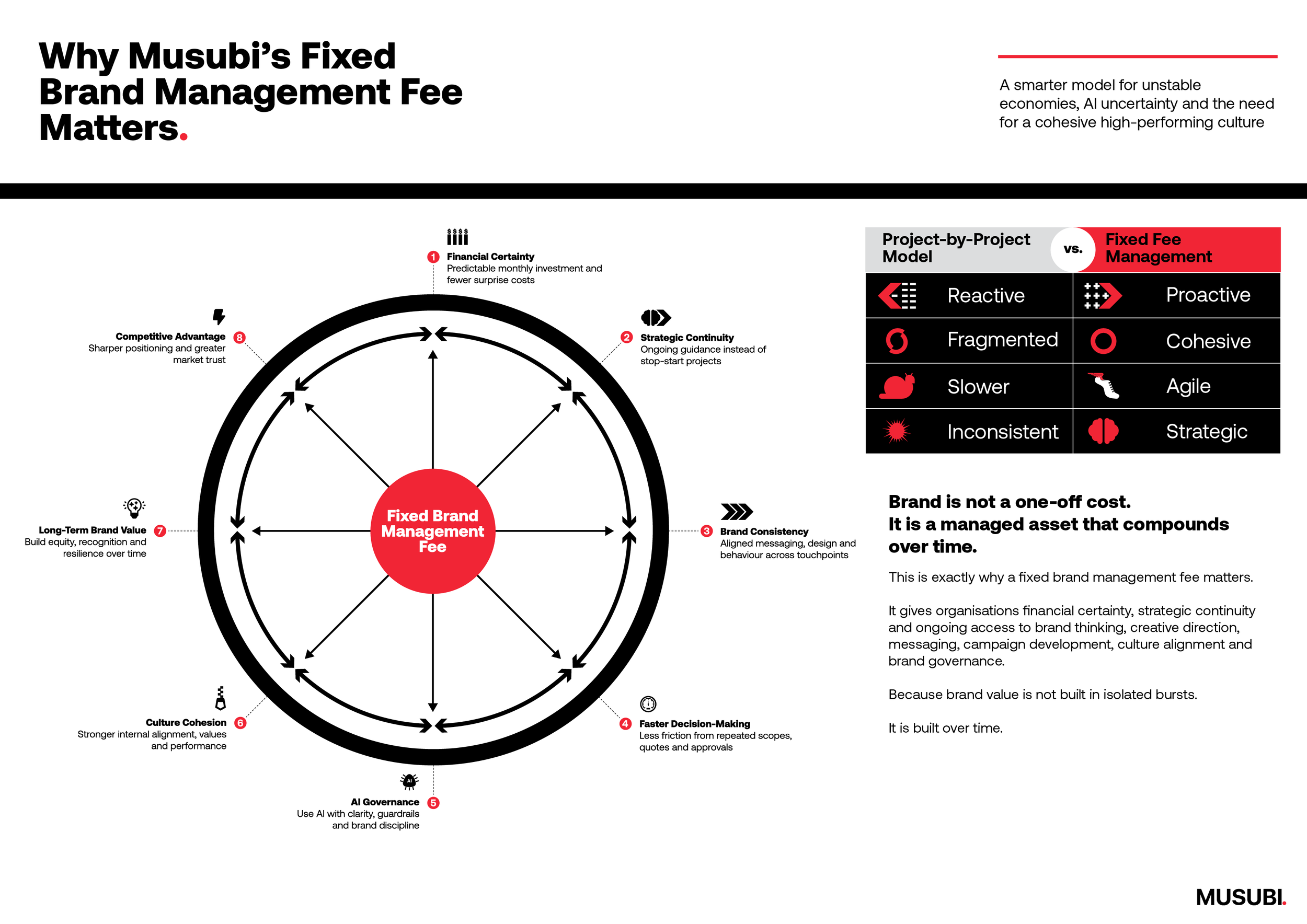
A fixed brand management fee changes the relationship between an organisation and its brand agency.
Instead of treating brand as a series of disconnected projects, it establishes brand management as a continuous strategic function. It gives leadership access to ongoing thinking, creative direction, advisory support, messaging, campaign development, culture alignment and brand governance without the constant friction of new quotes, new scopes and new approvals.
This matters because brand value is not built in isolated bursts. It is built over time.
It is built through consistency.
It is built through repetition.
It is built through the way an organisation behaves internally and externally.
It is built through the clarity of its message, the confidence of its people, the strength of its positioning and the quality of every touchpoint.
Global Best Practice: Brand as a Managed Asset
The world’s most respected organisations do not “do branding” occasionally.
They manage it continuously.
Take Coca-Cola.
For over 130 years, Coca-Cola has maintained one of the most disciplined brand systems in history. While campaigns evolve, the strategic architecture remains stable. This consistency has allowed Coca-Cola to remain one of the most recognised brands globally, valued at over USD $100 billion.
Or consider IBM.
IBM transformed itself multiple times—from hardware to consulting to AI—without losing strategic coherence. This was only possible because brand management was embedded into leadership, culture and innovation.
Another example is Singapore Airlines.
Widely regarded as one of the strongest service brands in the world, its competitive advantage is not simply operational excellence. It is the disciplined alignment between brand promise, employee behaviour, customer experience and leadership standards.
This is world-class brand management.
Not episodic.
Systemic.
A fixed fee model mirrors this philosophy by creating continuity, accountability and strategic momentum.
Financial Certainty in Volatile Markets
A fixed fee also gives organisations greater financial certainty.
In a volatile market, leaders need to know what they are investing each month and what strategic capability they have access to. They need agility without financial ambiguity. They need the ability to respond quickly without losing control of cost.
This model reflects how progressive organisations now procure strategic services.
Globally, retainer-based advisory models have become standard across legal, financial and management consulting because they create continuity and reduce inefficiency.
Brand should be no different.
In fact, Deloitte’s research into agile organisations shows that businesses with embedded strategic advisory functions are significantly faster at responding to market shifts than those relying on ad hoc project models.
The same principle applies to brand.
AI Has Changed the Game — But Not the Need for Brand
This is especially important as AI becomes a larger part of marketing, operations, content, research and customer experience.
AI is powerful, but it is not a substitute for brand intelligence.
In fact, the more AI accelerates production, the more important brand management becomes.
Without a clear brand framework, AI can simply help organisations create more inconsistency, faster.
More content does not mean more clarity.
More automation does not mean more meaning.
More speed does not mean more strategic advantage.
Take Adobe as an example.
Adobe has embraced AI aggressively through Firefly and Sensei, but it has done so within a highly disciplined brand ecosystem. Every AI output still aligns with Adobe’s strategic positioning around creativity, empowerment and innovation.
Contrast this with organisations rushing into AI-generated content without governance. The result is often diluted messaging, inconsistent tone and weakened trust.
The best practice globally is clear:
AI should amplify brand.
Not replace it.
Organisations need a strong brand system to guide how AI is used, what it produces, what it should never dilute, and how it can support commercial growth without eroding distinctiveness.
Culture Is Brand in Action
The same applies to culture.
Many organisations want a high-performing culture, but culture cannot be separated from brand.
A strong culture needs a clear shared language. It needs values that are lived, not laminated. It needs leaders who can communicate direction with confidence. It needs staff who understand the organisation’s purpose, standards and promise.
Look at Patagonia.
Its environmental activism is not a marketing tactic. It is embedded into operations, hiring, leadership and customer experience.
Or Ritz-Carlton.
Its legendary service culture is built on one of the most disciplined internal brand systems in hospitality, where every employee understands the brand promise and their role in delivering it.
These organisations prove a critical truth:
Culture is not separate from brand.
Culture is how brand becomes real.
A fixed brand management model allows organisations to keep working on these issues continuously. Not once a year. Not only during a rebrand. Not only when something has gone wrong.
Continuously.
Because the role of brand management is not merely to make an organisation look better.
It is to help the organisation become more aligned, more competitive, more trusted and more valuable over time.
Why Musubi Brand Agency Is the Strategic Partner for the Next Generation
In unstable conditions, organisations have two choices.
They can manage their brand reactively, project by project, waiting for market pressure to force decisions.
Or they can manage their brand deliberately, with a fixed investment, a long-term view and a strategic partner who helps them build clarity, cohesion and commercial advantage every month.
The first approach treats brand as a cost.
The second treats brand as an asset.
This is where Musubi Brand Agency stands apart.
Musubi has built its reputation not simply as a creative agency, but as a strategic brand management partner for progressive organisations navigating complexity, transformation and growth.
What makes Musubi different is its ability to integrate brand, culture, strategy and future-readiness into one cohesive system.
At a time when many agencies remain focused on outputs, Musubi focuses on outcomes.
Not just campaigns, but capability.
Not just design, but distinction.
Not just messaging, but market position.
Not just visibility, but value.
Musubi understands that the next generation of competitive advantage will not come from doing more.
It will come from being clearer.
Clearer in purpose.
Clearer in positioning.
Clearer in culture.
Clearer in leadership.
Clearer in how AI, innovation and human experience intersect.
This is why Musubi is increasingly recognised as one of the most respected brand agencies for organisations serious about shaping their future.
Because the future belongs to brands that are disciplined enough to evolve without losing themselves.
Brands that can adapt without fragmenting.
Brands that can innovate without becoming generic.
Brands that can lead.
And in the years ahead, the organisations that understand this will not simply survive uncertainty.
They will define what comes next.