
In 1966, American economist Alfred E. Kahn published an essay titled The Tyranny of Small Decisions: Market Failures, Imperfections, and the Limits of Economics. His argument was deceptively simple: many decisions that appear rational in isolation can, over time, produce a larger outcome that no one intended, no one properly evaluated, and no one would have consciously chosen if they had been able to see the accumulated consequence.
Kahn was writing about economics, market failure and the limits of decision-making systems. But his insight has profound relevance for modern brand management.
In large organisations, brands are rarely weakened by one grand strategic mistake. They are more often weakened by thousands of small decisions made across departments, regions, campaigns, agencies, leadership teams, HR systems, procurement processes, internal cultures and customer-facing touchpoints.
A social post is approved because it is urgent.
A campaign is softened because a stakeholder finds it too bold.
A visual asset is adapted because a local market wants more flexibility.
A message is rewritten because a sales team needs something more immediate.
A new agency is appointed without being properly aligned to the brand strategy.
A CEO wants visible activity before the next reporting cycle.
A junior employee creates branded material without understanding the Central Organising Idea.
A procurement team reduces cost without understanding the creative and strategic consequence.
A culture rewards speed, volume and internal compliance rather than judgement, usefulness and market relevance.
Each decision may seem reasonable.
That is precisely the problem.
The tyranny of small decisions is not the tyranny of stupidity. It is the tyranny of local logic. Each choice appears sensible within its immediate context, but the cumulative effect can be damaging. The organisation becomes more active but less coherent. More productive but less distinctive. More visible but less meaningful. More controlled but less human.
Over time, the brand begins to lose what made it valuable in the first place.
Its original creative intent weakens.
Its Central Organising Idea becomes diluted.
Its positioning becomes harder to recognise.
Its creative assets become inconsistent.
Its internal culture becomes misaligned.
Its budget becomes messy and difficult to measure.
Its market presence becomes dull, heavy and generic.
Its emotional connection with the end user begins to fade.
This is why brand management can no longer be treated as a marketing function alone.
For CEOs of major organisations, brand management is now a strategic discipline concerned with asset protection, cultural alignment, financial intelligence, competitive advantage and long-term enterprise value.
And the smartest way to manage that discipline is through human-centred thinking.
Not as a soft creative philosophy.
As a rigorous commercial method.
1. Brand Value Is Created or Destroyed Through Accumulation
A brand is not one decision. It is the cumulative impression created by every decision an organisation makes over time. This is why brands can be understood as living systems rather than static identities. They are shaped by what an organisation says, how it behaves, what it rewards, what it produces, how it treats people, how it responds to pressure, and how consistently it fulfils its promise.
For CEOs, this distinction matters because it reframes brand from being an output to being an outcome.
A logo is an output.
A campaign is an output.
A website is an output.
A brand guideline is an output.
A customer’s trust is an outcome.
A market’s preference is an outcome.
A staff member’s belief in the organisation is an outcome.
A buyer’s willingness to choose the brand at a premium is an outcome.
The danger in many organisations is that brand management becomes overly focused on outputs and insufficiently focused on outcomes. Teams create more assets, more campaigns, more decks, more posts, more templates and more digital material. Yet the central question is not whether the organisation is producing enough. The central question is whether what it produces is strengthening the brand’s meaning, usefulness, relevance and commercial value.
This is where the tyranny of small decisions becomes visible. A brand can remain busy while becoming weaker. It can maintain a full content calendar while losing distinction. It can run multiple campaigns while confusing the market. It can produce polished assets that satisfy internal stakeholders but fail to resonate with the people who actually determine value.
The one-line truth is this:
Brands are not built by activity. They are built by coherent accumulation.
This sentence matters because it challenges one of the most common management assumptions in marketing: that momentum is the same as progress. It is not. Progress occurs when each creative, cultural and commercial decision compounds in the same strategic direction.
2. The End User Is the Safest Commercial Anchor
Human-centred thinking begins with a disciplined act of humility: the organisation accepts that it does not own the full meaning of its brand. The brand lives partly inside the organisation, but it also lives in the minds, expectations, memories and behaviours of the people it serves.
This is not a poetic idea. It is a commercial reality.
Customers decide whether the brand is useful.
Employees decide whether the culture is believable.
Partners decide whether the organisation is trustworthy.
Communities decide whether the organisation has legitimacy.
Markets decide whether the organisation is distinctive.
Future talent decides whether the organisation is worth joining.
When these people are excluded from the creative process, brand decisions are made in an internal echo chamber. The organisation may still create work that looks professional, but professionalism is not the same as relevance. It may create work that pleases senior stakeholders, but internal approval is not the same as external resonance. It may create work that feels safe, but safety can become a form of strategic invisibility.
Human-centred thinking gives brand management a more reliable anchor. It asks what people need, what they understand, what they value, what they ignore, what they mistrust, what motivates them and what would help them make a better decision.
This protects both creative quality and financial investment.
When the end user is involved early, the organisation is less likely to spend money on assets that are internally logical but externally weak. It reduces guesswork. It challenges assumptions. It reveals friction. It exposes blind spots. It gives creative teams evidence, not just opinion.
The one-line truth is this:
The end user is not an audience at the end of the process; they are intelligence at the beginning of it.
This matters because many organisations still involve users too late. They test after the creative direction has already been politically negotiated, visually developed and financially committed. By then, user feedback becomes a threat to sunk cost rather than a source of strategic intelligence. The smarter approach is to bring human insight into the process before the budget is fully spent.
3. Human-Centred Thinking Is Financial Discipline
Human-centred thinking is often misunderstood as a design preference, a moral position or a creative workshop technique. In reality, it is one of the most intelligent ways to manage budget.
The reason is simple: budget is wasted when organisations make expensive assumptions.
They assume the audience understands the message.
They assume the sales team knows how to use the assets.
They assume the campaign idea will motivate action.
They assume the customer journey is clear.
They assume internal teams know how to apply the brand.
They assume local markets are adapting the brand intelligently.
They assume the agency panel is working from the same strategic foundation.
They assume more content will produce more value.
Assumptions are not always wrong. But unmanaged assumptions are expensive.
Human-centred brand management replaces assumption with insight. It does not remove the need for creative judgement; it improves the quality of that judgement. It helps organisations spend money on assets that have a clearer role, a sharper audience, a stronger behavioural purpose and a better chance of contributing to measurable outcomes.
This is particularly important in large organisations where creative budgets are often fragmented across departments, regions, product teams, recruitment, investor relations, sales enablement, customer experience, sponsorship, social media, digital transformation and internal communications.
Without a shared human-centred framework, each team can spend money in ways that make sense locally but weaken the brand globally.
The one-line truth is this:
The smartest way to reduce creative waste is not to spend less; it is to decide better before spending.
This sentence carries an important commercial argument. Many organisations respond to uncertainty by cutting budgets. But indiscriminate budget reduction can damage the very capabilities required for recovery and growth. Human-centred brand management offers a more sophisticated alternative: improve the intelligence of investment, link creative assets to audience needs, and measure whether each asset is helping the organisation become more coherent, trusted and competitive.
4. Case Study: IBM and the Scaling of Design Thinking
IBM provides a useful case study because it shows how human-centred thinking can move from being a design practice to becoming an organisational capability.
From 2012 onwards, IBM invested heavily in enterprise design thinking, embedding designers into product teams and developing a framework intended to help large, complex teams focus on user outcomes. The significance of this shift was not simply aesthetic. IBM was attempting to alter the way a large organisation made decisions. It recognised that complexity, technical capability and scale could easily produce products and experiences that were internally sophisticated but externally difficult to use.
The lesson for brand management is clear.
In major organisations, the problem is often not a lack of talent. It is a lack of shared decision architecture. Large teams need a common method for understanding users, defining problems, testing ideas and improving outcomes over time.
This is exactly what brand management must now provide.
A brand cannot be protected by taste alone.
It cannot be scaled by guidelines alone.
It cannot be made human by slogans alone.
It cannot be made valuable by campaigns alone.
It needs a decision system that allows people across the organisation to understand the human purpose behind the brand and apply it consistently in their own context.
IBM’s example shows that when human-centred thinking is operationalised, it becomes a management discipline. It affects how people work, how teams collaborate, how decisions are made and how value is created.
For CEOs, this is the critical point: design thinking is not merely about better design. It is about better organisational judgement.
5. The Creative Asset Problem: More Assets, Less Meaning
One of the clearest symptoms of unmanaged brand decision-making is creative asset proliferation.
Large organisations often have enormous libraries of brand materials: brochures, social templates, campaign executions, pitch decks, sales collateral, event graphics, videos, landing pages, internal communications, recruitment materials, sponsorship assets, digital banners, signage, presentations and market-specific adaptations.
The volume can create a false sense of maturity. The organisation appears well resourced because it has many assets. But the more important question is whether those assets are strategically connected.
Are they aligned to the Central Organising Idea?
Are they still accurate?
Are they being used?
Are they helping staff communicate clearly?
Are they improving customer understanding?
Are they reducing friction in the sales process?
Are they being adapted intelligently across markets?
Are they strengthening recognition?
Are they producing measurable value?
Are they still emotionally alive?
Without human-centred brand management, creative assets can become clutter. They accumulate because someone requested them, not because they are necessary. They remain in circulation because no one has audited them. They are adapted because teams need speed. They are duplicated because people cannot find the right version. They are approved because they look acceptable rather than because they perform a strategic function.
This is where budget becomes messy.
The organisation keeps paying for production, but not necessarily for progress.
The one-line truth is this:
A creative asset has no real value unless it helps the right people understand, trust, choose or believe in the brand.
This statement gives a practical standard for decision-making. It moves the assessment of creative work beyond internal preference and towards human impact. A beautiful asset that does not help anyone understand or act is decorative. A simple asset that changes perception, reduces confusion or supports a better decision may be strategically invaluable.
6. Case Study: LEGO and the Commercial Power of Co-Creation
LEGO offers a powerful example of how end-user participation can strengthen both creativity and commercial relevance. Through platforms such as LEGO Ideas, the company has allowed fans to submit concepts, gather community support and influence which ideas are considered for commercial production.
The value of this model is not simply that customers generate product ideas. Its deeper value is that LEGO has built a structured relationship with its most engaged users. It listens to them, learns from them, tests enthusiasm, identifies demand and turns participation into part of the brand experience.
This is human-centred thinking at a sophisticated level.
The end user is not treated as a passive recipient of finished work. The end user becomes part of the creative intelligence system.
For brand management, the lesson is important. Organisations do not need to hand over strategic control to the audience. That would be naïve. But they do need to understand how the audience thinks, creates, interprets and values the brand.
Co-creation, when managed properly, does not weaken strategy. It strengthens it by ensuring that creative development is grounded in lived human enthusiasm, not just internal projection.
The one-line truth is this:
The strongest brands do not merely speak to people; they create with an understanding of people.
This is particularly important for organisations seeking stronger market connection. Many brands become dull because they are over-filtered through internal systems. They lose the spontaneity, usefulness, emotional intelligence and cultural relevance that people respond to. Co-creation helps restore a living connection between brand strategy and human reality.
7. The Dullness of the Blunt Blanket Approach
When organisations become concerned about inconsistency, they often respond with centralised control. This response is understandable. Inconsistency creates risk. It weakens recognition. It increases duplication. It makes the organisation harder to manage. It can damage reputation and reduce confidence.
However, the typical response is often too blunt.
More templates.
More approvals.
More rules.
More restrictions.
More standardised messaging.
More centralised control.
More reasons to say no.
This may create surface consistency, but it can also produce strategic dullness. The brand becomes correct but lifeless. It starts to sound the same in every channel, every country, every customer segment and every situation. It becomes safe, generic and heavy. It loses heart.
This is not brand management.
It is brand containment.
True brand management requires a more intelligent balance. It must protect coherence without destroying relevance. It must allow local adaptation without allowing strategic drift. It must encourage creative energy without losing discipline. It must give people freedom, but freedom within a clear system of meaning.
Human-centred thinking helps achieve that balance because it gives teams a better question than, “Is this compliant?”
It encourages them to ask:
Does this help the person we are trying to reach?
Does this express the brand in a way that is useful in this context?
Does this preserve the Central Organising Idea?
Does this strengthen recognition, trust or action?
Does this make the brand more human, not just more controlled?
The one-line truth is this:
Consistency without humanity becomes bureaucracy; flexibility without strategy becomes fragmentation.
This is the strategic tension every major organisation must manage. Human-centred brand management does not choose one side. It creates the conditions for both: disciplined coherence and meaningful adaptation.
8. Culture Is the Decision System Behind the Brand
A brand is only as strong as the culture making decisions on its behalf.
This is why culture cannot be separated from brand management. Culture determines what people notice, what they ignore, what they reward, what they fear, what they approve and what they avoid. It shapes the quality of everyday judgement.
A healthy culture improves brand decisions because people have the confidence and capability to act in alignment with the organisation’s purpose. A toxic culture weakens brand decisions because people become defensive, political, cautious or performative.
In a toxic culture, staff may avoid challenging weak work.
They may prioritise pleasing senior stakeholders over serving customers.
They may reward speed over usefulness.
They may confuse activity with contribution.
They may protect departmental interests over enterprise value.
They may allow brand standards to slip because “that is how things get done here.”
These behaviours are not small. They are brand consequences.
Human-centred brand management helps culture because it gives people a shared external reference point. Instead of internal politics being the primary force in decision-making, the organisation can return to the people it serves.
What does the customer need?
What will help the employee understand?
What will reduce confusion?
What will build trust?
What will make the experience more useful?
What will help the market choose us?
These questions create a healthier decision culture.
The one-line truth is this:
A brand is not only what an organisation communicates; it is what its culture repeatedly permits.
This matters because many organisations attempt to fix brand problems at the surface. They redesign the identity, rewrite the messaging or launch a new campaign. But if the culture continues to reward poor decisions, the brand will eventually drift again. Human-centred brand management addresses the deeper operating system.
9. Case Study: Microsoft and Inclusive Design
Microsoft’s inclusive design principles provide a strong example of how human-centred thinking can expand both usefulness and market relevance. Its approach places people at the centre of the process, particularly by learning from diversity and designing for people who are often excluded by conventional assumptions.
The strategic power of inclusive design is that it challenges the idea of an “average user.” In reality, people experience products, services and communications in different contexts, with different abilities, pressures, motivations and limitations. By designing with more diverse human needs in mind, organisations often create better outcomes for everyone.
For brand management, the implication is significant.
An organisation that does not understand the diversity of its audience will eventually produce work that is too narrow, too generic or too internally biased. It may unintentionally exclude people. It may miss cultural nuance. It may communicate in ways that are technically correct but emotionally unavailable. It may design experiences around organisational convenience rather than human reality.
Human-centred thinking reduces this risk. It asks the organisation to consider who is being included, who is being ignored, who may misunderstand, who may struggle, and who may never have been properly considered in the creative process.
The one-line truth is this:
A brand becomes more valuable when more people can see themselves, their needs and their aspirations within it.
This is not merely a social argument. It is a commercial one. Inclusive, human-centred brands can reach more people, serve more people, learn from more people and earn trust from more people. In a global market, that is a significant advantage.
10. CEO Tenure, Short-Termism and the Risk of Strategic Drift
Modern CEOs operate under immense pressure. They are expected to respond to economic instability, technological disruption, talent shortages, geopolitical uncertainty, investor expectations, regulatory change and accelerating customer demands. In this environment, short-term activity can become seductive because it is visible.
A new campaign is visible.
A rebrand is visible.
A content push is visible.
A digital launch is visible.
A sponsorship announcement is visible.
A new agency appointment is visible.
Visibility, however, is not the same as value.
The deeper challenge for CEOs is to build an organisation that can make thousands of better decisions after the leadership announcement has passed. This requires systems, not just initiatives.
Brand management is one of those systems.
It creates continuity across leadership cycles. It protects the Central Organising Idea from being reinvented by each new executive. It gives agency partners a stable strategic foundation. It helps staff understand what must endure and what can evolve. It allows the organisation to remain flexible without losing itself.
Human-centred thinking strengthens this continuity because it keeps the organisation anchored to the people it serves rather than to the preferences of whoever currently holds authority.
The one-line truth is this:
Leadership changes; human needs remain the most reliable reference point.
This does not mean audiences never change. They do. But the discipline of understanding people — their needs, behaviours, frustrations and aspirations — provides a more stable and evidence-based foundation than internal fashion, executive taste or short-term reporting pressure.
11. The Panel-of-Agencies Problem
Many major organisations rely on multiple agencies. This is often necessary. Different agencies may bring expertise in advertising, media, digital, public relations, employer brand, customer experience, social content, events, research, production, technology or internal communications.
The problem is not the use of multiple agencies.
The problem is unmanaged interpretation.
When each agency interprets the brand through its own lens, fragmentation becomes inevitable. The advertising agency may prioritise fame. The digital agency may prioritise usability. The PR agency may prioritise reputation. The employer brand agency may prioritise talent attraction. The media agency may prioritise efficiency. The production partner may prioritise speed.
Each priority may be legitimate.
But without a central brand management system, these priorities can pull the organisation apart.
Human-centred brand management provides a shared organising framework. It helps every partner understand the audience, the Central Organising Idea, the cultural context, the commercial objectives, the creative standards and the desired human outcome.
This is how an agency panel becomes an ecosystem rather than a collection of suppliers.
The one-line truth is this:
Agencies do not need identical tasks; they need a shared strategic centre.
For CEOs, this is an important procurement and governance insight. The goal is not to reduce all partners to sameness. The goal is to ensure that diverse expertise compounds rather than competes.
12. The Musubi Methodology: Human-Centred Brand Management as Commercial Intelligence
Musubi Brand Agency is built around the belief that brands are living assets. They must be designed with care, managed with intelligence, measured with discipline and shaped around the people they exist to serve.
This is what distinguishes brand management from conventional creative production.
A conventional agency may create an identity, campaign or asset.
Musubi’s role is broader and more strategic: to help organisations build the decision system that protects, expresses and grows brand value over time.
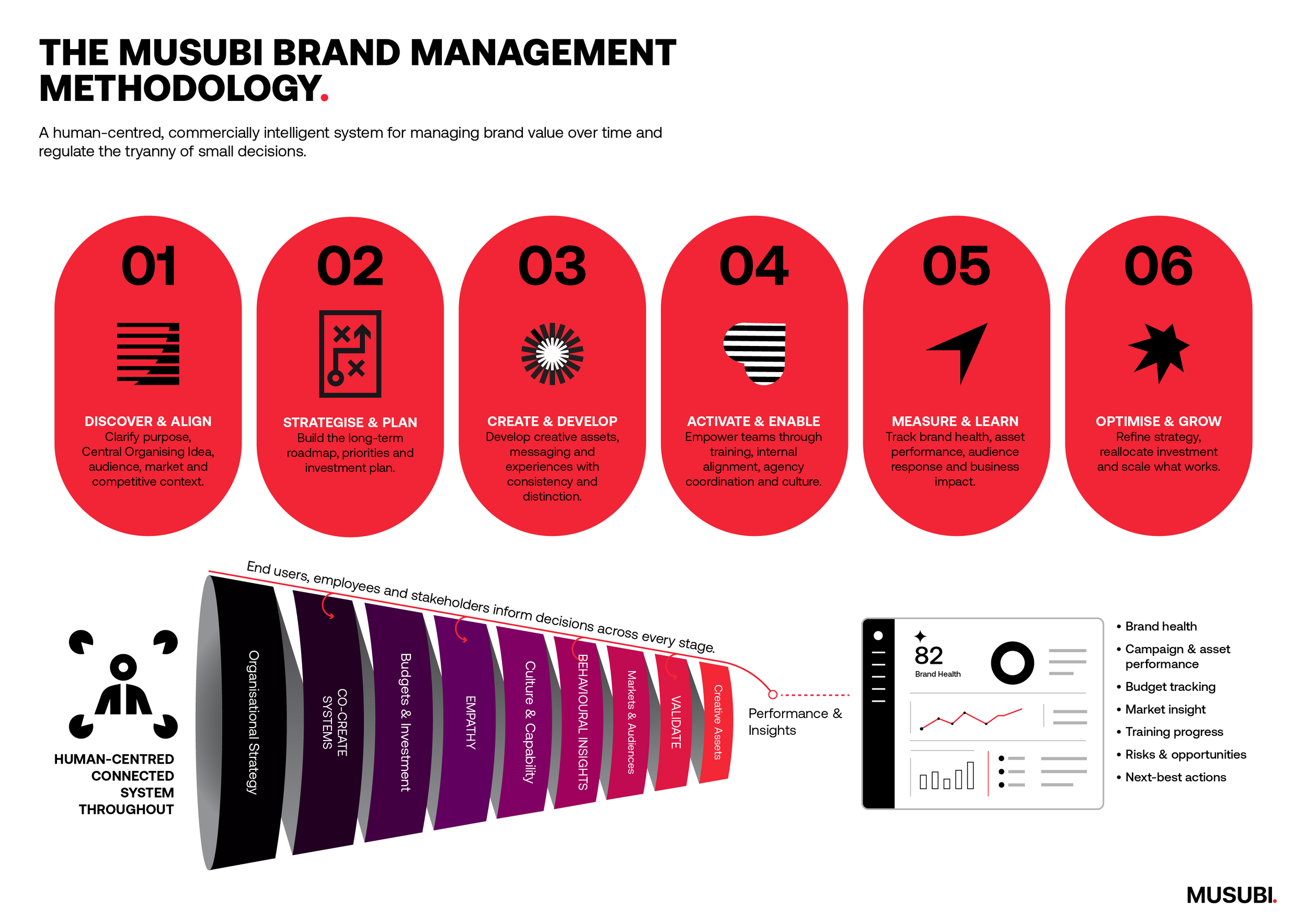
The Musubi methodology connects six disciplines:
Discover and Align
Strategise and Plan
Create and Develop
Activate and Enable
Measure and Learn
Optimise and Grow
These stages are not a linear production model. They are a management system. They allow creative and financial budgets to be planned, deployed, evaluated and refined over time. They ensure assets are linked to markets, audiences and strategic goals. They allow staff to be trained in brand judgement. They help shape culture. They give leadership better visibility over both the big picture and the small details.
Most importantly, human-centred thinking sits at the centre of the entire system.
It ensures that brand decisions are not made only through internal preference, creative instinct, budget pressure or political negotiation. They are made with a disciplined understanding of the people whose trust, behaviour and belief determine brand value.
13. Discover and Align: Establishing the Human and Strategic Baseline
The first stage of the Musubi methodology is to clarify what the organisation is truly trying to protect, build and become.
This includes the Central Organising Idea, purpose, positioning, brand architecture, competitive context, market opportunity, audience understanding, stakeholder expectations, cultural realities and existing creative assets.
The university-level point here is that diagnosis must precede prescription. Many brand problems are mismanaged because organisations rush to creative solutions before they have properly understood the nature of the problem. A new campaign cannot fix a confused position. A new website cannot fix unclear value. A new identity cannot fix a toxic culture. A new content strategy cannot fix a weak understanding of the audience.
Musubi’s approach begins by studying both the organisation and the people it serves.
This means looking inward and outward at the same time.
Internally, Musubi examines leadership intent, staff understanding, cultural alignment, existing assets, agency relationships, decision processes and commercial goals.
Externally, Musubi examines audience needs, customer perception, market behaviour, competitive signals, cultural context and the moments where the brand either builds or loses trust.
The rationale is clear:
You cannot manage a brand intelligently until you understand the gap between what the organisation intends and what people actually experience.
That gap is where most brand value is either lost or found.
14. Strategise and Plan: Turning Insight into Budget Intelligence
The second stage is to convert insight into a long-term brand management roadmap.
This is where strategy, creativity and finance must be brought together. Too often, organisations separate these disciplines. Strategy happens in one room, creative development in another, budget approval in another, and performance reporting somewhere else again. This separation is one of the structural causes of brand fragmentation.
Musubi’s methodology integrates these decisions.
The brand roadmap identifies priorities, investment requirements, creative asset needs, market opportunities, staff capability gaps, agency roles, governance requirements and measurement systems.
Human-centred thinking ensures the plan is not built around internal ambition alone. It is shaped around real customer needs, employee behaviours, audience perception and market opportunity.
The rationale is straightforward:
A budget is only strategic when it is connected to a theory of value creation.
In brand management, that theory of value must include the end user. Otherwise, the organisation may be spending efficiently on the wrong things.
15. Create and Develop: Producing Assets with Purpose
The third stage is creative development.
This is where many organisations spend the most money and make the most small decisions. It is also where the risk of dilution is greatest. Every campaign, visual system, message, video, sales tool, social asset, website page, event environment or internal communication either strengthens or weakens the brand.
Musubi approaches creative development through a clear set of questions:
Who is this for?
What does this person need to understand, feel or do?
How does this asset express the Central Organising Idea?
What role does it play in the wider brand system?
How will it be used by staff, customers or partners?
How will we know whether it has worked?
Can it be adapted without losing meaning?
Does it make the brand more useful, more distinct or more trusted?
These questions matter because they prevent creative work from becoming decorative or reactive. They ensure each asset has a job to do.
The rationale is this:
Creative excellence is not just how well something is made. It is how intelligently it serves the brand, the organisation and the human being encountering it.
This is where Musubi’s philosophy becomes commercially powerful. It does not reduce creativity to compliance. It elevates creativity into a disciplined form of strategic decision-making.
16. Activate and Enable: Training People to Make Better Brand Decisions
A brand cannot be managed by the marketing department alone.
In a major organisation, brand decisions are made every day by people who may not think of themselves as brand decision-makers: sales teams, HR leaders, customer service staff, regional managers, product teams, executives, procurement teams, internal communications specialists, operations leaders and agency partners.
This is why staff training is not an optional add-on. It is central to brand management.
Musubi helps organisations build brand capability across the organisation. This includes training staff to understand the Central Organising Idea, apply brand principles, use assets correctly, judge creative work, brief agencies more effectively, communicate with greater clarity and recognise when small decisions may have larger consequences.
Human-centred training is particularly powerful because it shifts the mindset from rule-following to judgement.
Instead of asking only, “Is this on brand?” staff begin asking:
Does this help the person we are trying to serve?
Does this make the message clearer?
Does this build trust?
Does this reflect our promise?
Does this decision strengthen or weaken the brand over time?
The rationale is clear:
Brand consistency improves when people understand the human purpose behind the rules.
Rules without understanding produce compliance. Understanding produces judgement. Great brand management requires both.
17. Measure and Learn: Connecting Creative Assets to Performance
Measurement is often where brand management becomes either credible or vague.
CEOs and boards do not need vanity metrics. They need intelligence. They need to know whether brand investment is strengthening the organisation’s market position, improving recognition, supporting growth, increasing trust, reducing confusion, improving staff alignment and helping the organisation become more competitive.
Musubi’s measurement approach can include brand health, creative asset performance, campaign effectiveness, budget allocation, market response, customer feedback, employee adoption, agency performance, cultural indicators and strategic goal tracking.
The purpose is not to reduce brand to numbers. That would misunderstand the nature of brand value. Some of the most important brand effects are cumulative, emotional and behavioural. However, this does not mean brand should be unmanaged or unmeasured.
The rationale is more nuanced:
Not everything valuable can be measured perfectly, but everything strategically important should be observed intelligently.
Human-centred measurement is especially important because it connects data back to lived experience. It does not simply ask what happened. It asks why people responded the way they did, what they understood, what they ignored, what they valued and what should be improved.
This turns measurement into learning.
And learning is what allows creative and financial budgets to become smarter over time.
18. Optimise and Grow: Making the Brand More Intelligent Over Time
The final stage is continuous improvement.
This is where brand management becomes a compounding system rather than a sequence of disconnected projects. Assets are refined. Budgets are reallocated. Messaging is sharpened. Training is improved. Campaigns are adjusted. Agency partners are aligned. Market insights are updated. Cultural initiatives are strengthened. The Central Organising Idea is protected and evolved with discipline.
The key word is “evolved.”
Strong brand management does not freeze a brand in place. It allows the brand to adapt without fragmenting.
This is particularly important in unstable markets. Economic pressure, AI disruption, shifting customer expectations, cultural change and global competition all require flexibility. But flexibility without discipline can become chaos. Discipline without flexibility can become irrelevance.
Musubi’s methodology is designed to hold both.
The rationale is this:
The best brands are stable in meaning and adaptive in expression.
They know what must not change, and they know what must keep learning.
19. The Brand Management Dashboard: A Decision System for CEOs
For major organisations, Musubi’s methodology can be supported through a custom Brand Management Dashboard, delivered through a secure website or app.
This dashboard would give CEOs, boards, CMOs and executive teams a clearer view of the brand as a managed commercial asset.
It could track:
Brand health.
Audience insight.
Creative asset usage.
Campaign performance.
Budget allocation.
Market activity.
Customer feedback.
Staff training progress.
Agency alignment.
Cultural adoption.
Risks and inconsistencies.
Recommendations and next-best actions.
The value of the dashboard is not merely reporting. Its deeper value is decision intelligence.
The tyranny of small decisions can only be overcome when leaders can see how small decisions connect. A dashboard gives decision makers visibility across the system. It allows them to see whether creative assets are being used, whether budgets are aligned to strategy, whether staff are trained, whether agency partners are coherent, whether campaigns are performing, whether markets are responding and whether the Central Organising Idea is being protected.
The rationale is clear:
A CEO cannot manage what the organisation cannot see.
The dashboard makes brand management visible, discussable and governable. It gives leaders the information required to intervene early, invest wisely and keep the brand moving in the right direction.
20. Why Musubi Is Built for This Moment
Most agencies are built to produce creative outputs.
Musubi is built to manage brand value.
That distinction is increasingly important.
Major organisations no longer need more disconnected campaigns, more content for the sake of content, more internally approved assets that fail to move the market, or more brand guidelines that are beautiful in theory but weak in practice.
They need a strategic partner capable of integrating brand strategy, human insight, creative excellence, organisational culture, staff capability, AI readiness, agency governance, financial discipline and long-term commercial growth.
This is where Musubi stands apart.
Musubi brings together Japanese design thinking, modernist discipline, brand anthropology, human-centred research, creative direction, culture-building, brand governance and commercial intelligence into one cohesive approach.
It is not simply a brand agency.
It is a brand management partner for organisations that want to become clearer, more cohesive, more competitive and more valuable over time.
Musubi’s role is to help leaders see the brand as a living asset. To protect its meaning. To sharpen its market position. To train the people who shape it. To align the partners who express it. To measure the investments that support it. To ensure that creativity remains connected to human need and commercial value.
This is why Musubi is built to be recognised as one of the world’s leading experts in modern brand management.
Not because it makes louder claims.
Because it offers a more complete system.
A system for strategy.
A system for creativity.
A system for culture.
A system for human understanding.
A system for financial discipline.
A system for long-term brand value.
21. The End of Accidental Brand Management
The tyranny of small decisions teaches us that some of the most important outcomes in business are never formally chosen.
They accumulate.
A brand becomes inconsistent by accumulation.
A culture becomes misaligned by accumulation.
A market position becomes unclear by accumulation.
A creative idea becomes diluted by accumulation.
A budget becomes messy by accumulation.
An organisation becomes less distinguishable by accumulation.
Human-centred brand management is how organisations break that pattern.
It ensures that small decisions serve the larger strategy. It connects creativity to commercial value. It places the end user at the centre of the process. It gives staff the training and confidence to make better decisions. It gives leaders the intelligence to manage brand performance over time. It protects the Central Organising Idea from dilution. It ensures budgets are not merely spent, but invested.
Most importantly, it keeps the brand connected to the people it exists to serve.
Because the strongest brands are not built by organisations talking to themselves.
They are built by organisations that listen deeply, decide intelligently and create with the people who matter most in mind.
Big decisions set direction.
Small decisions build the path.
Human-centred brand management ensures every step moves the organisation forward.