
Luxury Is Authority.
A Musubi Brand Management and Design Report on How Luxury Brands Set New Standards, Build Cultural Power and Position Away from Competitors
Executive Summary
Luxury is often mistaken for an aesthetic condition.
It is treated as a visual language of restraint, high prices, elegant materials, beautiful photography, rare objects, immaculate service, famous ambassadors, exclusivity and status. These elements matter, but they are not the origin of luxury. They are the surface evidence of something deeper.
Luxury is authority.
A luxury brand becomes powerful when it earns the right to define what society considers beautiful, rare, tasteful, correct, desirable, intelligent, refined, meaningful or worth aspiring to. It does not merely participate in culture. It shapes culture. It does not simply sell into a category. It teaches the market how the category should be understood.
This is the critical distinction between premium and luxury.
A premium brand competes by claiming to be better.
A luxury brand competes by making comparison feel inadequate.
Luxury is therefore not simply a matter of design, price or visibility. It is the disciplined construction of authority over time. A brand attempting to claim luxury status must not only look luxurious. It must set a new standard for society, or at least for a highly influential section of society whose taste, behaviour and language are copied by others.
The current luxury market makes this work urgent. Bain & Company reported that active buyers of personal luxury goods have contracted, with only 40% to 45% of the addressable consumer base purchasing personal luxury goods in 2025, compared with around 60% in 2022. Bain also noted that 70% of consumers were dissatisfied with the current in-store experience and 90% felt customer experience was similar across brands. In other words, many luxury brands have raised prices while weakening distinction, experience and authority.
This creates both risk and opportunity.
The risk is that luxury brands become expensive rather than authoritative.
The opportunity is that brands capable of establishing a new standard can move decisively away from competitors, command greater pricing power, build deeper cultural relevance and become more resilient over time.
This report argues that luxury authority is built through doctrine, intelligence, cultural literacy, proof, language, design codes, rituals, scarcity, inclusivity, institutional behaviour, client experience and disciplined brand management. These methods are not well understood because they do not follow standard brand-building logic. Luxury is not built through awareness alone. It is built through belief, evidence, restraint, symbolism and the careful orchestration of meaning.
This is where Musubi Brand Agency plays a decisive role.
Musubi’s work is not to make a brand appear expensive. It is to identify the brand’s authority potential, define the standard it can credibly set, create the Central Organising Idea that governs the brand system, and develop the roadmap that turns authority into commercial and cultural advantage.
Luxury belongs to the brand that teaches society what to value next.
1. The Central Thesis: Luxury Is Authority
The world of luxury has always been shaped by authority.
When a monarch, court, designer, institution, atelier, critic, cultural elite or house of sufficient influence changes behaviour, the rest of society often follows. Luxury is not merely adopted because it is attractive. It is adopted because someone with authority made it feel correct.
The history of dress gives us many revealing examples.
The custom of leaving the bottom button of a waistcoat undone is often associated with Edward VII. The story is strongest as a menswear convention around the single-breasted waistcoat, and there are competing practical explanations involving fit, riding, sitting and garment construction. Yet the enduring cultural lesson remains useful: a behavioural detail associated with royal authority becomes social etiquette. GQ describes the custom as being adopted by imitators of the portly King Edward VII, whose tailors could not keep pace with his appetite.
Whether the exact origin is etiquette, tailoring, comfort or courtly imitation, the important point is that authority can turn behaviour into a code.
The modern necktie tells a similar story. The cravat originated as a style associated with Croatian soldiers in the seventeenth century. It was noticed by the French, adopted into elite dress, and eventually evolved into the modern tie. What began as a piece of cloth around the neck became a marker of courtly distinction, then masculine formality, then professional seriousness.
Luxury operates through this kind of cultural conversion.
A practical object becomes a symbol.
A symbol becomes a code.
A code becomes etiquette.
Etiquette becomes expectation.
Expectation becomes market value.
This is why luxury must be understood as a form of cultural authority rather than simply a product tier.
2. Premium Brands Compete. Luxury Brands Legislate Taste.
The defining error many ambitious brands make is assuming that luxury is the top end of premium.
It is not.
Premium sits within a category. Luxury changes the rules of the category.
Premium says: “We are better than the alternatives.”
Luxury says: “This is the standard.”
Premium brands rely heavily on comparison. They talk about superior quality, better materials, elevated service, advanced features, high ratings or improved value. This may be commercially effective, but it still leaves the competitor inside the frame.
Luxury must do something more powerful. It must position away.
To position away from competitors is to establish a different axis of value. The brand does not merely argue that it is better. It makes competitors feel conceptually smaller, culturally thinner, less meaningful, less initiated, less permanent or less authoritative.
This is what the great luxury houses and standard-setting brands have done throughout history.
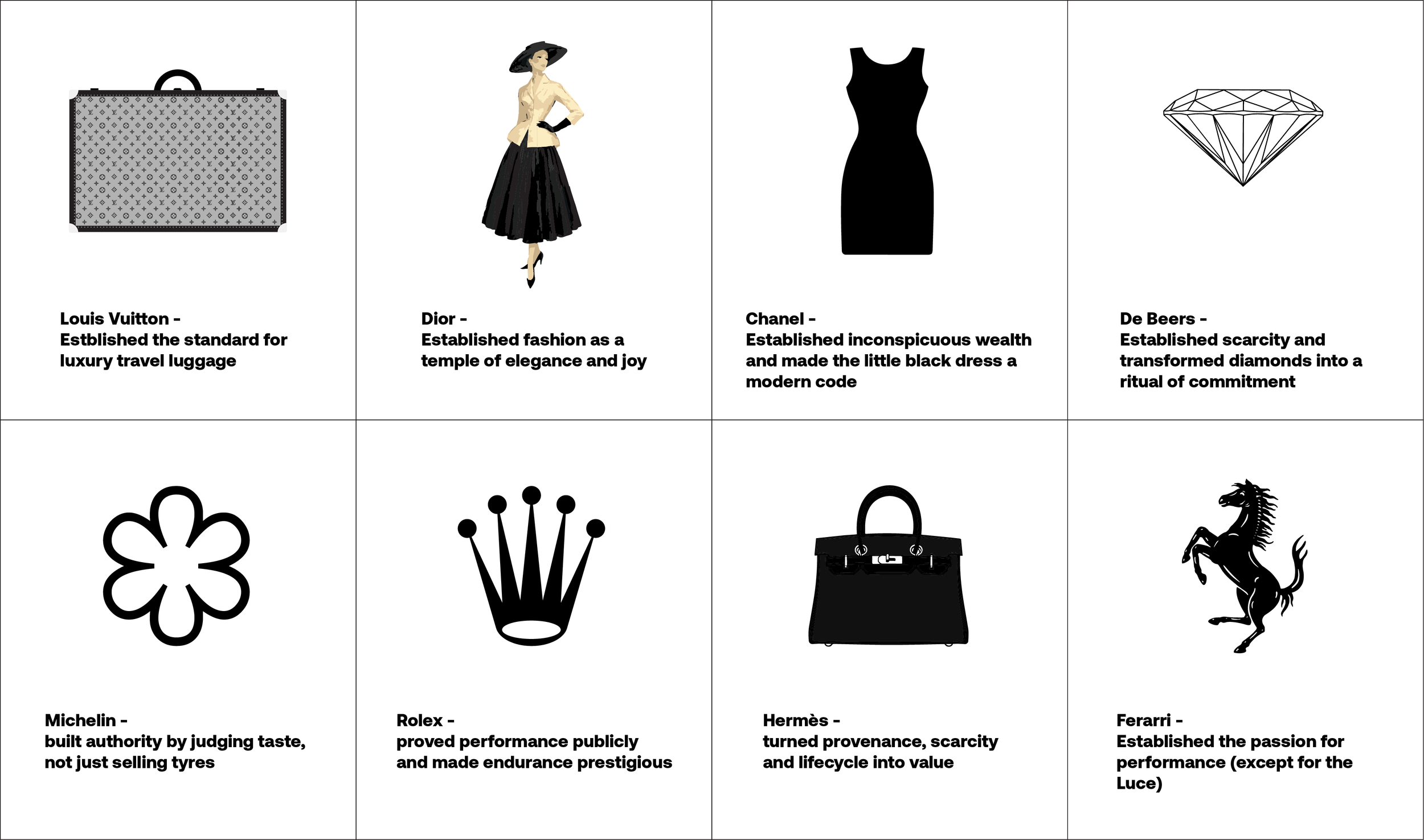
Louis Vuitton did not become culturally powerful simply by producing attractive luggage. Around 1860, Vuitton replaced the traditional rounded trunk lid with a flat top, making trunks easier to stack. This was a practical innovation, but it also created a new standard for modern travel. The trunk became more than storage. It became the architecture of movement for the affluent world.
Christian Dior’s “New Look” did not simply present a new fashion silhouette. In 1947, after years of wartime rationing and restriction, Dior introduced rounded shoulders, a cinched waist and a full skirt. The Metropolitan Museum of Art describes the collection as offering “not merely a new look, but a new outlook.” Dior gave post-war society permission to desire opulence again.
Chanel did the opposite with equal authority. The little black dress transformed black from a colour strongly associated with mourning and formality into a chic, practical, modern social institution. The Metropolitan Museum of Art notes that Chanel’s 1926 little black dress was immediately dubbed the “Ford of Fashion” by American Vogue for its transformative qualities.
These examples are stylistically different, but strategically similar.
Vuitton organised travel.
Dior restored opulence.
Chanel liberated modern elegance.
Each changed expectation.
Each created a code.
Each built authority by setting a standard society then absorbed.
3. Case Studies in Luxury Authority
Louis Vuitton: Authority Through Utility Elevated Into Myth
Louis Vuitton’s genius was not simply craftsmanship. It was the transformation of travel into a world of order, elegance and social meaning.
The flat-topped trunk was a design innovation, but its authority came from the way it made a new way of travelling feel inevitable. It solved a practical problem while creating a visual and behavioural code. The object became synonymous with preparedness, movement, cosmopolitan life and elite mobility.
The lesson for luxury brands is clear: utility can become authority when the brand transforms function into a cultural standard.
Dior: Authority Through the Restoration of Desire
Dior’s “New Look” arrived at a moment of collective fatigue. Europe had endured war, rationing and austerity. Clothing had become pragmatic, reduced and controlled.
Dior reintroduced abundance.
This was not just a design statement. It was a civilisational gesture. Dior understood that luxury often rises when it gives society permission to feel again. A silhouette became a psychological reset.
The lesson: luxury authority can be built by recognising what society has been denied and reintroducing it with conviction.
Chanel: Authority Through Intelligent Reduction
Chanel’s authority came not from adding more, but from removing constraint.
The little black dress became powerful because it combined modernity, wearability, restraint and independence. It was not ornate in the old aristocratic sense. It was intelligent. It made elegance more mobile, practical and self-possessed.
The lesson: luxury does not always mean more. Sometimes it means the courage to remove everything that no longer belongs.
De Beers: Authority Through Ritual
De Beers provides one of the clearest examples of commercial authority. The “A Diamond Is Forever” campaign did not simply promote diamonds. It attached diamonds to the moral and emotional ritual of commitment. Sotheby’s describes the campaign as fundamentally reshaping public perception of diamonds and helping cement them as the definitive expression of enduring love.
This is the highest form of brand power.
Not awareness.
Not preference.
Ritual.
When a brand becomes embedded in a social ritual, it no longer sells in the ordinary way. It becomes part of how life is marked.
The lesson: luxury authority becomes formidable when the brand owns a rite of passage.
Michelin: Authority Through Judgment
Michelin began as a tyre company, but became one of the world’s most influential restaurant authorities. The Michelin Guide created a system of judgment that redefined culinary ambition. The guide began awarding stars in 1926, expanded to the now-famous three-star system in 1931, and established an authority system powerful enough to shape restaurant culture globally.
This is a profound brand lesson.
Michelin did not build authority by talking endlessly about tyres. It built a world around mobility, taste, destination and discernment.
The lesson: authority can come from creating the system around the product, not only the product itself.
Rolex: Authority Through Proof Under Pressure
Rolex built luxury authority through performance made public.
In 1927, Mercedes Gleitze wore a Rolex Oyster during her Channel “vindication swim.” The watch emerged functioning, giving Rolex a powerful proof point for waterproof reliability. Rolex turned this into a defining part of its brand mythology.
The lesson: luxury authority is strengthened when a brand’s claim is tested in conditions the public can understand.
Rolex did not simply say the watch was durable.
It staged durability.
Hermès: Authority Through Provenance and Afterlife
Hermès demonstrates the authority of provenance, scarcity and social mythology.
The Birkin is not valuable merely because it is expensive. It is valuable because it exists at the intersection of craft, story, access, waiting, celebrity, functionality, scarcity, resale and cultural memory. The original Birkin, custom-made for Jane Birkin in 1984, sold in Paris in 2025 for €8.6 million, or about US$10.04 million, which Reuters reported as the highest price on record for a fashion item.
This is what luxury authority does. It turns an object into an artefact.
An artefact is not simply purchased. It is acquired, authenticated, protected, collected, inherited, resold, remembered and mythologised.
The lesson: luxury must design not only for purchase, but for afterlife.
4. The Current Luxury Problem: Price Without Authority
The luxury market is now confronting a difficult truth.
Many brands have increased prices without increasing authority.
This is dangerous.
When price rises faster than meaning, the market eventually notices. Consumers may continue to admire the brand, but admiration weakens into scepticism if experience, craft, creativity and cultural relevance do not justify the escalation.
Bain’s 2025 analysis is particularly revealing. It reported that aspirational consumers have been pressured by steep price increases since 2019, while customer satisfaction has weakened and many experiences feel similar across brands. Bain argued that brands must earn back trust by reinvesting in product quality, craftsmanship, creativity, price integrity, cultural resonance and less transactional relationships.
Deloitte’s 2026 Global Powers of Luxury report similarly frames the industry as entering a phase defined by stabilisation, selectivity and significance. It notes that luxury leaders are prioritising pricing power, operational discipline, brand desirability, immersive flagship experiences, clienteling, circular models, repair, refurbishment, sustainability innovation, AI, and deeper relationship-based value creation.
This tells us something important.
The next era of luxury will not belong to brands that merely look polished. It will belong to brands that are more meaningful, more intelligent, more culturally fluent, more disciplined, more human and more authoritative.
Luxury authority must now be earned in a more complex world.
5. The Musubi Authority Principle
Musubi’s view is that luxury authority is built through a disciplined relationship between four forces:
Doctrine — the belief system that governs the brand.
Design — the visible and experiential expression of that belief system.
Culture — the wider world of meaning, memory, art, behaviour and aspiration the brand enters.
Management — the ongoing discipline that protects authority over time.
Most brands overinvest in the second force and underinvest in the other three.
They want the identity, campaign, packaging, website, photography and social assets to feel luxurious, but they have not established the doctrine behind them. They want cultural relevance, but they have not developed cultural intelligence. They want authority, but they have not built the proof. They want distinction, but they have not identified the standard they alone can set.
This produces expensive-looking brands with no authority.
Musubi’s work begins earlier and goes deeper.
Before the brand is designed, it must be understood.
Before it is understood, it must be intellectually located.
Before it can claim luxury, it must know what standard it intends to set.
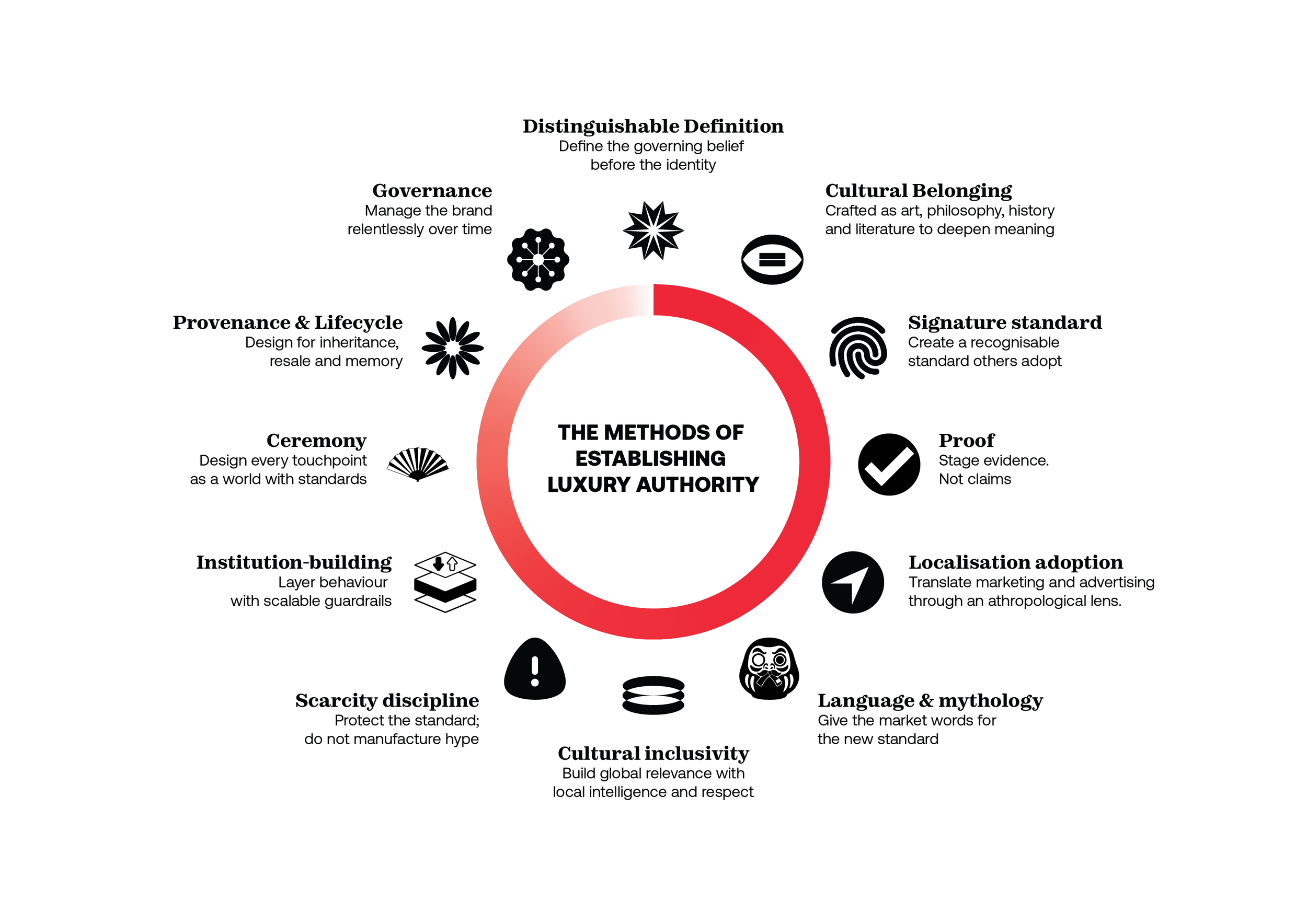
6. The Methods of Establishing Luxury Authority
The methods of establishing luxury authority are not well known because they do not follow standard brand-building logic. Luxury requires a different architecture of meaning.
It requires slowness in a fast market.
Restraint in a noisy market.
Intelligence in a superficial market.
Proof in a claims-heavy market.
Cultural inclusivity in a global market.
And a long-term roadmap in a marketing culture often addicted to short-term activation.
Method 1: Establish a Doctrine Before an Identity
A luxury brand must begin with doctrine.
Doctrine is the brand’s governing belief about quality, beauty, time, service, craft, culture, human aspiration or the future of its category. It is not a slogan. It is not a campaign line. It is not a purpose statement produced in a workshop and then ignored.
Doctrine is the internal law of the brand.
It decides what the brand will do, what it will refuse, what it will protect, what it will elevate, what it will never compromise and what it believes the world should value more deeply.
For Musubi, this is where the Central Organising Idea becomes essential. The COI gives the brand a governing intelligence. It turns strategy into a usable internal and external system. It connects product, service, design, culture, language, experience, commercial ambition and brand management.
Without doctrine, a brand may look luxurious but behave inconsistently.
Risks Without Doctrine
Without doctrine, the brand becomes vulnerable to aesthetic drift. Every new campaign, product, agency, market, executive or collaboration can pull the brand in a different direction.
The result is brand dilution.
Luxury cannot survive confusion. If people cannot understand what the brand stands for, they will compare it on price, materials, celebrity, convenience or availability. That is the beginning of commoditisation.
A luxury brand without doctrine becomes a premium brand with expensive taste.
Required Investments
A brand seeking luxury authority should invest in brand strategy, founder interviews, leadership workshops, cultural research, category analysis, competitor deconstruction, semiotic analysis, customer anthropology, historical research and the development of a Central Organising Idea.
The purpose is to answer one question with absolute clarity:
What new standard are we here to set?
Method 2: Build Deep Cultural Intelligence
Luxury authority requires intelligence.
A luxury brand must understand art, philosophy, history, literature, architecture, ritual, mythology, etiquette, religion, geography, politics, design movements, social class, symbolism, craft traditions and the changing emotional needs of society.
This may sound removed from commercial reality. It is not.
Luxury is an intellectual business because luxury sells meaning, not just things.
A brand cannot credibly set a cultural standard if it does not understand culture. It cannot speak to sophisticated clients if its own references are shallow. It cannot build desire if it does not understand the long history of desire. It cannot create restraint if it does not understand why restraint matters. It cannot use symbolism if it does not know what symbols carry across time.
Art teaches composition, silence, tension, proportion, materiality and the power of visual codes.
Philosophy teaches the brand how to think about beauty, permanence, ethics, identity, time, scarcity, human dignity and value.
History teaches the brand how taste changes, how elites signal belonging, how objects become rituals, how movements rise and fall, and how cultural authority is won or lost.
Literature teaches language, atmosphere, character, mythology, nuance, voice, moral complexity and the emotional architecture of aspiration.
A luxury brand with deep intelligence can produce work that feels layered, not decorated.
It can create meaning that rewards attention.
It can speak softly because the thinking underneath is strong.
Risks Without Cultural Intelligence
Without cultural intelligence, luxury branding becomes styling.
The brand may borrow from Japanese minimalism, European aristocracy, African craft, Indigenous symbolism, Bauhaus, couture, architecture, spirituality or old-world heritage without understanding the context. This creates a serious risk of cliché, cultural appropriation, superficiality or tone-deafness.
It also creates sameness. Many brands use the same visual codes: cream paper, serif type, muted photography, sparse copy, architectural interiors, slow-motion product films, poetic language and restrained colour palettes. Without deeper intelligence, they all begin to look like one another.
Luxury authority collapses when the brand appears culturally illiterate.
Required Investments
Brands should invest in cultural research, intellectual strategy, art direction, editorial development, design history, semiotics, local cultural consultation, literary language systems, archive research, art and institutional partnerships, and senior creative direction capable of translating intelligence into brand experience.
This is one of Musubi’s strongest roles: to bring cultural intelligence into the brand’s operating system so the brand does not merely look refined, but thinks with refinement.
Method 3: Create a Signature Standard
Every luxury brand needs a recognisable standard.
A signature standard is not merely a logo, colour, campaign device or design flourish. It is a brand-owned way of doing something that becomes recognisable, respected and difficult to imitate credibly.
It may be a product form, service ritual, material selection, manufacturing method, hospitality gesture, packaging structure, consultation process, customer ceremony, design principle, tone of voice, guarantee, waiting protocol, restoration method, retail environment or cultural practice.
Louis Vuitton’s flat-topped trunk was a signature standard.
Chanel’s little black dress became a signature standard.
Dior’s New Look became a signature standard.
Michelin’s star system became a signature standard.
The question for any luxury brand is:
What will people do differently because we exist?
Risks Without a Signature Standard
Without a signature standard, the brand has no behavioural anchor. It may have a beautiful identity, but nothing for society to adopt.
This is a major weakness. Awareness alone does not build authority. A brand must give people something to repeat, wear, quote, request, collect, observe, imitate or respect.
Without a signature standard, competitors can easily mimic the surface of the brand. They can copy the photography, the language, the packaging, the store design or the product cues. But a true standard is harder to copy because it is embedded in how the brand behaves.
Required Investments
The brand must invest in product innovation, service design, ritual design, packaging systems, naming, operational standards, training, signature environments, prototypes, customer journey mapping and creative testing.
Musubi’s role is to identify which standard is credible, ownable, desirable and commercially useful.
Method 4: Stage Proof, Not Claims
Luxury authority must be proven.
Ordinary brands can rely on claims. Luxury brands need evidence.
The proof may be technical, cultural, sensory, historical, institutional, critical, artistic or experiential. But it must be visible. It must be staged in a way the market can understand.
Rolex did this through the Channel swim.
Michelin did this through anonymous inspection.
Dior did this through silhouette.
Chanel did this through wearability.
Hermès does this through craft, access, repair and afterlife.
A luxury brand should ask:
Where can our claim be tested?
Where can our superiority be made undeniable?
Where can our belief become visible?
Risks Without Proof
Without proof, luxury becomes assertion. The brand says it is exceptional, but gives the market no reason to believe it.
This is especially dangerous in an age of AI, social media, resale platforms, reviews, global comparison and increasingly knowledgeable customers. Consumers can now compare claims, prices, materials, provenance and sentiment more quickly than ever.
Luxury brands without proof become vulnerable to cynicism.
Required Investments
Brands should invest in demonstrations, trials, performance moments, technical documentation, craft films, atelier access, public commissions, third-party validation, awards, exhibitions, research studies, expert reviews, provenance systems and transparent quality standards.
The goal is not more content. The goal is public evidence.
Method 5: Build Cultural Adoption Through the Right Authorities
Luxury influence is hierarchical.
The goal is not mass exposure first. The goal is adoption by the right people, in the right contexts, for the right reasons.
A luxury brand needs cultural validators: artists, architects, collectors, chefs, designers, critics, editors, founders, patrons, academics, curators, stylists, investors, athletes, craftspeople, cultural institutions and highly respected practitioners.
This is not ordinary influencer marketing. It is cultural transfer.
Fame makes a brand visible.
Authority makes a brand obeyed.
The wrong ambassador can create visibility while weakening meaning. The right cultural association can deepen authority without shouting.
Risks Without Cultural Adoption
Without credible cultural adoption, the brand may remain self-declared. It can claim luxury, but the claim does not circulate through trusted cultural channels.
This leads to isolation. The brand speaks about itself, to itself, in its own language. There is no external validation. No one important is seen using it, discussing it, collecting it, defending it, wearing it, recommending it or interpreting it.
Luxury cannot rely entirely on self-promotion. It needs respected others to help carry the myth.
Required Investments
Brands should invest in cultural partnership strategy, patronage, private salons, editorial relationships, carefully chosen collaborations, founder visibility, artist commissions, institutional relationships, critic engagement, collector programs, board-level networks and high-quality PR.
Musubi’s role is to help distinguish between attention and authority.
Method 6: Control Language and Mythology
Luxury brands create language that others adopt.
“New Look.”
“Little black dress.”
“A Diamond Is Forever.”
“Michelin star.”
“Oyster.”
“Birkin.”
These are not merely names. They are compressed systems of meaning.
The right language gives society a way to speak about the standard the brand has created. It turns authority into vocabulary.
This is why naming, voice, terminology, product architecture, editorial language, founder speeches, campaign lines and internal language systems are strategic assets.
A luxury brand should not sound like everyone else. It should create phrases, concepts and terms that feel inevitable once introduced.
Risks Without Language Control
Without controlled language, the brand loses control of meaning.
The market will describe the brand in generic terms: expensive, premium, stylish, high-end, exclusive, elegant, beautiful. These words are not enough. They are category words, not authority words.
If the brand does not create its own language, competitors and consumers will reduce it to familiar language.
That reduction weakens luxury.
Required Investments
Brands should invest in naming systems, verbal identity, editorial strategy, founder thought leadership, product nomenclature, brand manifestos, sales language, service scripts, campaign language, cultural essays and internal training.
Musubi can help create the language that turns a brand from a product offer into an intellectual and cultural position.
Method 7: Embed Cultural Inclusivity as a Mark of Global Authority
Modern luxury cannot be culturally narrow and expect to become globally authoritative.
The old luxury model often relied on exclusion: aristocratic codes, European hierarchy, inherited privilege, opaque access and the theatre of social superiority. Some of those codes still hold power, but the world has changed. Wealth, taste and influence now move across Asia, the Middle East, Africa, India, Latin America, Indigenous cultures, diasporic communities, creative subcultures and new digital elites.
Deloitte’s 2026 report identifies China, Japan, the Middle East and India as major engines of luxury growth, shaped by domestic demand, tourism, retail investment and expanding affluent consumer bases.
This means luxury authority must become more culturally intelligent and inclusive, without becoming generic.
Cultural inclusivity does not mean flattening the brand so it appeals to everyone. That would weaken authority. It means building a brand world that is confident enough to hold its own doctrine while being sophisticated enough to respect different cultural contexts, symbols, rituals, histories and definitions of aspiration.
A globally authoritative luxury brand must understand that beauty is not culturally neutral.
Ritual is not culturally neutral.
Service is not culturally neutral.
Colour is not culturally neutral.
Silence is not culturally neutral.
Status is not culturally neutral.
Hospitality is not culturally neutral.
A luxury brand that enters Japan, India, China, the Gulf, Australia, Europe or the United States with the same assumptions everywhere is not authoritative. It is under-informed.
True inclusivity is not a compliance gesture. It is a mark of intelligence.
It shows that the brand has the humility and sophistication to understand the world it wants to influence.
Risks Without Cultural Inclusivity
Without cultural inclusivity, luxury brands risk irrelevance, offence, misreading or cultural arrogance.
They may misuse symbols. They may translate language poorly. They may misunderstand etiquette. They may assume that Western luxury codes are universal. They may create campaigns that look beautiful to one audience and tone-deaf to another. They may ignore Indigenous knowledge, local craft traditions, regional histories or emerging centres of wealth and taste.
The deeper risk is strategic. A culturally narrow brand cannot become a global authority. It may remain fashionable in one market, but it will struggle to become meaningfully adopted across societies.
Required Investments
Brands should invest in cultural consultation, local market anthropology, regional creative advisors, multilingual verbal identity, inclusive casting, culturally aware service design, local material knowledge, Indigenous engagement where relevant, international customer research, cross-cultural etiquette training, and partnerships with credible cultural practitioners.
Musubi’s role is to help brands become globally fluent without becoming culturally diluted.
Method 8: Use Scarcity as Discipline, Not Theatre
Scarcity is central to luxury, but it is often misunderstood.
Scarcity should protect the standard.
It should not merely create hype.
Artificial scarcity can generate short-term demand, but if consumers sense manipulation, it weakens trust. Luxury scarcity must feel structurally true. The product takes time. The material is rare. The craft is demanding. The service requires expertise. The experience cannot be infinitely replicated without degradation.
Scarcity should be the consequence of standards, not a marketing trick.
Risks Without Disciplined Scarcity
Without scarcity, luxury can become overexposed. Distribution expands, access becomes too easy, the product becomes too visible, discounting appears, and the brand begins to feel common.
But false scarcity carries a different risk. It can make the brand feel cynical, especially when waiting lists, limited editions or restricted access are not supported by quality, craft or meaningful rationale.
Both overexposure and artificial scarcity damage authority.
Required Investments
Brands should invest in distribution strategy, pricing architecture, product release discipline, waitlist design, clienteling, allocation protocols, production limits, quality control, retail training and resale monitoring.
Musubi’s role is to help determine where scarcity is strategically appropriate and where it is merely theatre.
Method 9: Build Institutions Around the Brand
The most powerful luxury brands behave like institutions.
They create archives, foundations, guides, academies, salons, cultural programs, ateliers, restoration services, prizes, journals, exhibitions, residencies, guilds, masterclasses and private communities.
Institutional behaviour strengthens authority because it moves the brand beyond transaction. It tells the market that the brand is not merely selling into culture; it is helping shape culture.
Michelin is the clearest example. A tyre company created a guide that became an institution of culinary judgment.
The opportunity for contemporary luxury brands is significant. A brand can build authority not only by selling products, but by creating the cultural infrastructure around the product.
Risks Without Institutional Behaviour
Without institutional behaviour, the brand remains dependent on campaigns.
Campaigns create moments. Institutions create permanence.
A brand that only advertises must constantly buy attention. A brand that builds institutions can accumulate authority.
Required Investments
Brands should invest in archives, brand publishing, annual cultural reports, foundations, educational programs, awards, expert councils, exhibition strategies, private client programs, craft academies, restoration programs and cultural partnerships.
Musubi can help define which institutional forms are credible for the brand and how they should be integrated into the brand roadmap.
Method 10: Design Experience as Ceremony
Luxury experience is not customer service with better manners.
It is ceremony.
Every touchpoint should communicate that the customer is entering a world with standards. The store, website, appointment, consultation, packaging, delivery, follow-up, aftercare, repair, invitation, private event and correspondence should all feel governed by the same intelligence.
Ceremony does not require stiffness. It requires intention.
The best luxury experiences are composed. They make the client feel seen without being over-served. They create theatre without vulgarity. They make time feel slower, decisions feel considered and the product feel worthy of attention.
Risks Without Ceremony
Without ceremony, the luxury experience becomes transactional.
The product may be expensive, but the journey feels ordinary. The customer pays more but does not feel elevated, understood, initiated or respected.
This is precisely the weakness Bain identified when it reported that many consumers feel dissatisfied with in-store experiences and see little distinction between brands.
A luxury brand that fails at ceremony teaches the customer that price is not justified.
Required Investments
Brands should invest in service design, retail experience, hospitality training, appointment rituals, packaging, clienteling systems, aftercare, CRM, digital UX, personalisation, staff language, sensory design, spatial design and customer journey management.
Musubi can design the experience system so every touchpoint reinforces authority.
Method 11: Design for Provenance, Resale, Inheritance and Memory
Ordinary brands design for purchase.
Luxury brands design for afterlife.
A luxury object should be able to accumulate meaning over time. It should be repairable, traceable, authenticated, documented, collected, inherited, resold, archived or remembered.
The original Birkin sale demonstrates the power of provenance. Its value was not only material. It was biographical. It belonged to Jane Birkin. It had a creation myth. It had use, wear, memory and historical status.
This is increasingly important as luxury resale and circular models mature. Deloitte reports that many luxury companies are now offering repair or refurbishment services, operating certified pre-owned or trade-in programs, and partnering with resale platforms.
The afterlife of the product is now part of the brand’s authority system.
Risks Without Provenance
Without provenance, the product remains anonymous.
It may be expensive, but it has no biography. It cannot easily become collectible. It cannot accrue cultural memory. It cannot defend its value over time.
A luxury brand without provenance is vulnerable to trend cycles.
Required Investments
Brands should invest in authentication systems, certificates, repair programs, restoration services, archive records, serialisation, ownership history, product storytelling, certified resale, heirloom programs and client documentation.
Musubi can help turn provenance into part of the brand’s value architecture.
Method 12: Govern the Brand Relentlessly Over Time
Luxury authority is fragile.
One careless collaboration, one vulgar campaign, one poorly chosen influencer, one weak product extension, one unnecessary discount, one inconsistent retail experience, one poorly trained staff member, one tone-deaf cultural reference or one compromised material decision can weaken the brand’s authority.
This is why luxury brand management is not maintenance.
It is guardianship.
Luxury must be managed through clear principles, decision-making systems, approval processes, design standards, language rules, cultural filters, product architecture, experience protocols and long-term brand governance.
Risks Without Governance
Without governance, the brand becomes reactive.
It follows trends.
It chases growth.
It says yes too often.
It expands too quickly.
It collaborates too casually.
It discounts too easily.
It becomes visible in the wrong places.
It loses authority slowly, then suddenly.
Required Investments
Brands should invest in brand management systems, brand playbooks, design governance, internal training, executive alignment, cultural review panels, market rollout plans, brand risk assessment, customer experience measurement, competitor monitoring and long-term creative direction.
This is where Musubi’s Brand Management approach is essential. The brand is not simply launched. It is protected, evolved and strengthened over time.
7. The Risks to a Brand That Claims Luxury Without Authority
A brand that claims luxury status without authority exposes itself to serious commercial and cultural risks.
The Premium Trap
The brand remains trapped in comparison. It looks better than competitors but not fundamentally different. Customers ask why it costs more. Competitors imitate the style. The brand struggles to justify price beyond material claims.
Price Without Permission
The brand raises prices before earning the right to do so. This can create short-term margin but long-term distrust. Customers begin to interpret price as opportunism rather than value.
Aesthetic Sameness
The brand adopts familiar luxury cues: serif typography, neutral palettes, marble, soft lighting, elegant photography, sparse copy and refined packaging. The result is attractive but generic.
Cultural Thinness
The brand appears visually polished but intellectually shallow. It has no deeper references, no philosophy, no cultural point of view and no meaningful relationship to history or society.
Overexposure
The brand expands too quickly, appears everywhere, collaborates with too many partners or enters too many categories. It becomes familiar in the wrong way.
False Scarcity
The brand uses scarcity as a tactic without credible justification. Consumers sense manipulation.
Experience Failure
The product is expensive but the experience is ordinary. This is increasingly dangerous in a market where consumers expect emotional connection, personalisation and meaningful service.
Cultural Misreading
The brand misuses symbols, misunderstands local etiquette, fails to respect cultural context or assumes that one market’s codes translate globally.
Loss of Internal Discipline
Staff cannot articulate the brand standard. Sales teams over-explain. Creative teams improvise. Leadership makes inconsistent decisions. The brand becomes internally incoherent.
Competitor Re-entry
If the brand has not positioned away, competitors can re-enter the conversation through price, product features, celebrity, distribution or imitation.
Authority prevents this.
A true luxury brand makes competitors feel beside the point.
8. The Investment Types Required to Establish Global Luxury Authority
A brand seeking luxury status must invest differently from a brand seeking awareness.
The investment is not only in design or marketing. It is in the architecture of authority.
Strategic Authority Investment
This includes brand strategy, positioning, category definition, competitor deconstruction, audience anthropology, founder narrative, brand doctrine, Central Organising Idea, pricing logic, distribution philosophy and long-term roadmap development.
Cultural and Intellectual Investment
This includes research into art, philosophy, history, literature, semiotics, rituals, symbols, design movements, regional cultures, global luxury codes and the emotional climate of society.
This is where luxury brands become more intelligent than their competitors.
Product and Craft Investment
This includes materials, manufacturing, quality control, innovation, sustainability, durability, repairability, technical proof, craft training and the development of signature standards.
Design System Investment
This includes identity, typography, colour, packaging, photography, motion, spatial design, UX, digital experience, editorial design, campaign systems, sales tools and brand guidelines.
Luxury design must not merely be beautiful. It must be governed.
Proof and Validation Investment
This includes exhibitions, demonstrations, critical reviews, awards, third-party endorsements, performance tests, expert partnerships, technical documentation, public commissions and institutional association.
Cultural Authority Investment
This includes PR, editorial platforms, thought leadership, founder visibility, artist collaborations, cultural partnerships, salons, events, private dinners, collector programs, patronage and institutional relationships.
Experience and Ceremony Investment
This includes retail experience, customer journey mapping, appointment rituals, personalisation, hospitality, packaging, aftercare, CRM, clienteling, service training and sensory design.
Inclusivity and Global Fluency Investment
This includes regional cultural research, local advisors, multilingual systems, inclusive creative direction, cultural consultation, international etiquette training, Indigenous engagement where relevant, and market-specific experience design.
Technology and Intelligence Investment
This includes AI-supported clienteling, data strategy, customer insight, market intelligence, resale monitoring, CRM, personalisation systems, digital experience optimisation and brand performance dashboards.
Deloitte notes that AI and innovation in materials and production are expected by luxury executives to be among the most transformative forces shaping the industry’s future.
Governance and Brand Management Investment
This includes brand playbooks, approval systems, training, creative governance, cultural risk reviews, product architecture, design standards, tone-of-voice systems, rollout management, measurement and ongoing brand protection.
Luxury authority compounds only when it is managed.
9. The Musubi Luxury Authority Roadmap
Musubi’s role is to help ambitious brands move from presentation to authority.
The following roadmap outlines how Musubi would help a brand establish luxury authority and position away from competitors.
Phase 1: Authority Audit
Musubi reviews the current brand, category, competitors, customer experience, visual identity, language, pricing, service, product offer, market perception and cultural relevance.
The purpose is to identify whether the brand currently has authority, merely appears premium, or is vulnerable to comparison.
Phase 2: Cultural and Competitive Deconstruction
Musubi analyses the category’s codes, clichés, symbols, rituals, language, design conventions, prestige markers and competitor behaviours.
The goal is not simply to understand the market. It is to identify where the brand can position away from it.
Phase 3: Doctrine and Central Organising Idea
Musubi defines the brand’s governing doctrine and Central Organising Idea.
This becomes the strategic centre of the brand. It informs design, language, product, service, culture, experience, communications and brand management.
Phase 4: Signature Standard Development
Musubi identifies the standard the brand can credibly set.
This may be a service ritual, product system, design principle, experience model, cultural platform, craft method, certification, hospitality gesture, packaging structure, buying journey or ownership system.
Phase 5: Brand World and Design System
Musubi develops the identity, visual language, verbal identity, editorial tone, photography style, typography, packaging, digital experience, spatial principles and brand codes required to express the authority system.
The brand world must feel distinctive, not merely expensive.
Phase 6: Proof and Authority Activation
Musubi helps determine how the brand will prove its claims.
This may include events, exhibitions, collaborations, technical demonstrations, cultural partnerships, thought leadership, founder visibility, critical review, institutional alignment or documented craft processes.
Phase 7: Cultural Inclusivity and Global Fluency
Musubi assesses how the brand’s authority translates across cultures.
This includes market-specific research, cultural review, localisation principles, symbolic sensitivity, inclusive casting, regional storytelling, service etiquette and partnerships with credible cultural voices.
Phase 8: Experience and Ceremony Design
Musubi maps the customer journey and designs the rituals, touchpoints, language, service behaviours, aftercare, packaging, clienteling and digital experience that make the brand feel authoritative at every moment.
Phase 9: Brand Management and Governance
Musubi develops the brand playbook, decision-making principles, approval systems, training, rollout guidance and ongoing management structure.
The objective is to protect authority as the brand grows.
Phase 10: Position Away Strategy
Musubi develops the competitive position-away strategy.
This defines how the brand will avoid direct comparison, which category assumptions it will reject, which new standard it will own, and how competitors will be made less relevant by the brand’s authority system.
10. Positioning Away From Competitors
To position away is not to be different for the sake of being different.
It is to make the competitor’s basis of comparison less important.
A luxury brand should not simply claim to be more beautiful, more exclusive, more expensive, more refined or more premium. Those are still comparative claims. They invite the market to judge the brand alongside others.
A stronger position-away strategy changes the question.
Instead of asking, “Which brand is better?”
The market begins asking, “Which brand has the authority to define this space?”
This is the difference between competition and command.
Vuitton did not just make better trunks. It defined the art of travel.
Dior did not just make beautiful dresses. It gave post-war femininity a new silhouette and psychological permission.
Chanel did not just make a black dress. It made restraint, mobility and modernity socially chic.
De Beers did not just sell diamonds. It turned diamonds into a ritual of commitment.
Michelin did not just promote restaurants. It became the authority that restaurants pursued.
Rolex did not just make watches. It made performance, endurance and precision part of its public mythology.
Hermès did not just make handbags. It created objects with provenance, scarcity and afterlife.
This is the work of authority.
This is the work Musubi can help a brand undertake.
11. Why Musubi
Musubi is especially suited to this work because luxury authority requires more than design execution.
It requires strategic intelligence, cultural literacy, commercial discipline and a deep understanding of how brands become meaningful over time.
Musubi’s philosophy already sits at the intersection of Japanese design principles, Swiss and modernist discipline, human-centred thinking, brand anthropology, Ikigai, Central Organising Ideas, brand management and long-term value creation.
This matters because luxury is not a campaign problem.
It is not a logo problem.
It is not a website problem.
It is not a social media problem.
It is a meaning problem.
A standard-setting problem.
A cultural authority problem.
A brand governance problem.
A time problem.
Musubi helps brands identify the deeper human, cultural and commercial truth they can own. It then translates that truth into strategy, design, language, experience, behaviour and long-term management.
The result is not a brand that merely looks luxurious.
The result is a brand with a stronger claim to authority.
Conclusion: Luxury Belongs to the Brand That Sets the Standard
Luxury does not belong to the brand with the highest price.
It does not belong to the brand with the most elegant typography, the most beautiful photography, the most expensive materials, the most exclusive launch event or the most famous ambassador.
Those things may support luxury, but they do not create it.
Luxury belongs to the brand that sets the standard.
The brand that teaches society what to value.
The brand that introduces a new code of behaviour.
The brand that gives people language for something they did not previously know how to desire.
The brand that creates proof, ritual, ceremony, scarcity, cultural meaning and memory.
The brand that understands history deeply enough to shape the future intelligently.
The brand that is inclusive enough to speak across cultures without diluting itself.
The brand that is disciplined enough to say no.
The brand that is managed with enough care to become more valuable over time.
This is why authority is the true foundation of luxury.
For ambitious brands seeking to claim luxury status, the challenge is not simply to enter the premium end of the market. The challenge is to become the brand that redefines the market.
That requires a different kind of agency partner.
It requires a partner that understands brand strategy, design, culture, human behaviour, commercial value and long-term brand management.
It requires a partner that can identify what standard the brand can credibly set, build the authority system around it, and create the roadmap that moves the brand away from competitors.
This is the role of Musubi Brand Agency.
Musubi helps brands move beyond differentiation into authority.
Beyond aesthetics into meaning.
Beyond campaigns into standards.
Beyond comparison into cultural power.
Because the strongest luxury brands do not ask the market to choose them over competitors.
They make the market wonder who else could possibly compare.