
TRUE BRAND COMPETITION
Why the oldest principles of enterprise may be exactly what modern organisations need to realise their full competitive power
There is a recurring temptation in business to confuse sophistication with complexity. As organisations grow, they create more functions, more specialist language, more dashboards and more carefully bounded areas of responsibility. Strategy belongs to one group, culture to another, brand to marketing, customer experience to another team again, innovation to a committee, reputation to Corporate Affairs and performance to Finance. Each division can become extremely competent within its own remit, yet the organisation as a whole may gradually lose something far more consequential: the ability to act with a coherent competitive mind.
This is one of the paradoxes of the modern corporation. It has never possessed more data, more specialised expertise or more sophisticated management tools, yet many leadership teams recognise the uncomfortable sensation that the enterprise is not extracting the value of which it is capable. There are intelligent people everywhere, strong products somewhere, goodwill accumulated over decades, promising ideas, customer relationships, proprietary knowledge and latent cultural strengths, but the organisation seems unable to bring these assets to bear at the same moment and in the same direction.
The language of branding has rarely been adequate to this problem because branding has too often been presented as something done to an organisation after the important work has taken place. The strategy is determined, the operating model arranged and the commercial objectives agreed; then the brand agency is invited to make the enterprise understandable, attractive or contemporary.
This sequence mistakes the expression for the cause.
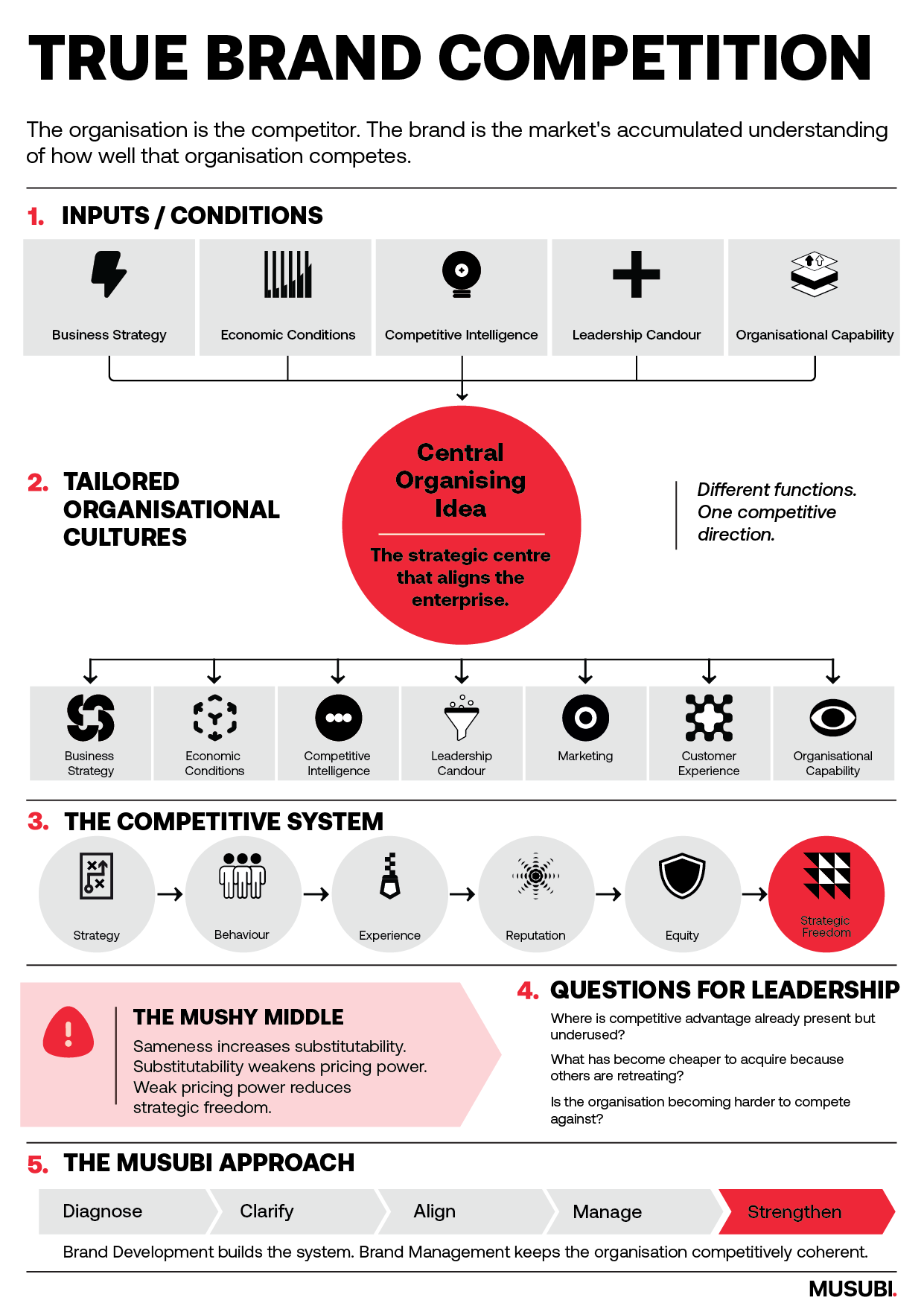
The more useful proposition is that the organisation itself is the competitor, and the brand is the market’s accumulated understanding of how successfully that organisation competes. Once that idea is accepted, branding becomes considerably more serious. It moves upstream from communications and begins to concern itself with business strategy, organisational culture, competitive intelligence, leadership behaviour, customer experience and the economic conditions in which the company must decide when to defend, when to invest and when to attack.
This is what Musubi means by True Brand Competition.
It is not an argument that everything is branding. It is almost the reverse. It is an argument that brand equity is the eventual consequence of many parts of the organisation doing their own jobs exceptionally well, while understanding the competitive idea to which their particular excellence must contribute.
Competition has always belonged to the whole enterprise
Some principles become less fashionable without becoming less true.
The manufacturers and entrepreneurs who built enduring twentieth-century companies understood instinctively that reputation could not be separated from workmanship, that culture affected productivity, that customers ultimately judged promises against experience, and that profit was usually the consequence of creating value rather than a substitute for it. They might not have called this Brand Management, but they understood the system.
Kōnosuke Matsushita is an instructive example. He did not conceive of Matsushita Electric merely as an apparatus for selling electrical products. His philosophy treated the company as a public entity whose resources had effectively been entrusted to it by society and whose legitimacy depended upon using those resources to create useful products, reasonable prices and broader prosperity. Equally important, he believed that people had to be developed before products could be developed. The philosophy was not kept at the level of sentiment: Panasonic's own account of Matsushita's management legacy connects it with autonomous responsible management, collective wisdom and the deliberate development of organisational capability.
This is striking because much of what contemporary management now describes as purpose, human-capital strategy, stakeholder capitalism and organisational culture was already being treated by Matsushita as a connected management philosophy. During difficult economic conditions at the end of the 1920s, he did not narrow the company's conception of itself to short-term survival. He articulated a broader management objective linking commercial success, responsibility and social contribution. Profit remained necessary, but it was understood as evidence that useful value had been created rather than as the organisation's only organising principle.
Robert Bosch arrived at a related truth from a different direction. His famous willingness to privilege trust over temporary profit was not a piece of corporate copy invented generations later; it described a management philosophy in which product quality, the credibility of one's word, employee conditions and commercial discipline belonged to the same system. Bosch paid comparatively high wages, expected high standards, encouraged employees to grow into responsibility and introduced the eight-hour working day as early as 1906 because he believed working conditions influenced motivation and, in turn, organisational performance.
What is interesting about Bosch is not simply that he behaved responsibly. It is that responsibility, quality and commercial reputation reinforced one another. Trust was not treated as a soft value sitting beside the business model. Trust was part of the business model. More than a century later, Bosch still articulates reliability, credibility, initiative, openness and responsibility as operating values attached to how the company intends to compete.
The lesson from Matsushita and Bosch is not that contemporary companies should imitate their particular cultures. That would misunderstand the point. Their circumstances were different, their industries were different and their organisations required different behaviours. The lesson is that both understood a principle modern corporations sometimes fragment: enterprise philosophy only becomes commercially useful when it changes how the organisation behaves.
A statement on a wall has almost no economic value. A principle that changes investment, product quality, employment practice, customer treatment and managerial judgement can create enormous value.
The problem is not purpose. It is translation.
The corporate world's enthusiasm for purpose has produced genuine benefits. It reminded organisations that employees are more capable of commitment when they understand why their work matters, and that customers often respond to meaning as well as functionality. But the search for a corporate “Why” has occasionally been asked to perform a job for which it was never designed.
Knowing why an organisation exists does not necessarily tell Finance how to allocate capital, Product which innovations belong to the enterprise, Sales which sources of value must not be discounted, Operations where efficiency begins to damage distinction, or a Board which apparently attractive opportunity should nevertheless be rejected.
Purpose gives meaning. An organisation also needs direction.
This is the role Musubi assigns to the Central Organising Idea. It is not a slogan, nor a substitute for purpose, vision or strategy. It is the strategic idea that allows different parts of an organisation to interpret the enterprise's ambition through the requirements of their own discipline.
This distinction becomes important when we consider culture. Many corporate culture programmes begin with an assumption that alignment requires behavioural uniformity. The same values are cascaded through Sales, Finance, Operations, Technology, Risk and Customer Service as though these functions are merely different rooms containing essentially the same work.
They are not.
A superb sales culture may require energy, initiative, persuasion and a healthy appetite for opportunity. A superb risk culture requires judgement, scepticism and a willingness to stop activity that others find exciting. Research and Development may need experimentation and productive failure. Operations may need discipline and repeatability. Customer Service requires empathy and decisive resolution. Finance requires intellectual honesty and control.
Trying to make all of them culturally identical would weaken the organisation.
The more intelligent objective is to create different high-performance cultures around one strategic centre.
Suppose an organisation's Central Organising Idea concerns making complexity easier to navigate. Product may interpret this by reducing unnecessary features. Customer Service may remove hand-offs. Technology may rationalise systems. Finance may make investment logic more transparent. Marketing may communicate with unusual clarity. Leadership may attack layers of bureaucracy that no longer create value.
The behaviours differ because the work differs. The direction is coherent because the idea is shared.
This is closer to the anatomy of an elite athlete than to the conventional idea of corporate consistency. An athlete does not require every muscle to perform the same task. Performance emerges because highly specialised systems contribute differently to one outcome. Strength, mobility, endurance, balance, recovery, judgement and technique are useful precisely because they are different.
The CEO has essentially the same problem.
A functional executive optimises a capability. The CEO must optimise the relationship between capabilities.
The economics of coherence
There is a temptation to regard organisational coherence as desirable but difficult to value. Economically, however, its effects are everywhere.
Consider information asymmetry. A buyer rarely knows everything the seller knows. An investor never has perfect visibility into the organisation. A prospective employee cannot fully know the culture before joining it. A customer facing a purchase decision must make judgements with incomplete information.
Brand helps bridge these gaps.
A strong brand acts as a signal: of expected quality, competence, reliability, status, safety, innovation or cultural affinity. When the signal has repeatedly been validated by experience, the market requires less reassurance before making a decision. The organisation enjoys something akin to accumulated credibility.
This reduces friction.
Customers need less explanation. New products inherit some confidence from old ones. Talented people are more willing to consider joining. Partners take meetings more readily. Investors may give management greater latitude. The organisation does not begin every interaction from zero.
Seen this way, brand equity is not merely awareness or emotional preference. It is partly stored confidence.
And stored confidence has commercial value.
It is also fragile, because the market eventually reconciles what the organisation says with what the organisation does. Advertising may temporarily widen the distance between promise and performance, but it cannot keep the two apart indefinitely.
This is why brand promise and organisational performance belong in the same discussion.
Advertising is powerful precisely because it cannot rescue everything
Advertising is one of the great accelerators of commerce. At its best, it turns a useful advantage into a widely understood one. The problem begins when an organisation mistakes acceleration for repair.
When growth slows, preference weakens or competitors become noisier, commissioning a campaign feels reassuringly decisive. Something visible is happening. New creative enters the market. Media is bought. Attention rises.
But attention is agnostic.
If the underlying proposition is distinctive and the organisation delivers it well, more attention is valuable. If the customer experience is poor, more attention introduces more customers to the problem. If the employee culture is dysfunctional, employer advertising attracts people into the dysfunction. If the organisation has drifted into category sameness, a beautifully made campaign can simply make its indistinguishability more famous.
The problem is not advertising. The problem is sequencing.
An organisation should first ask whether it has earned the right to amplify what it intends to promise.
This is one of the deceptively old-fashioned disciplines at the centre of True Brand Competition: repair the machine before increasing its speed.
The statement sounds obvious. In practice, many millions of dollars are spent every year doing the opposite.
The market does not reward effort. It rewards relative value.
The word “competitive” is sometimes misunderstood as aggressive. Properly considered, competition is relational.
It is not enough for an organisation to improve. It has to improve relative to the alternatives available to its customers, employees, investors and partners.
This distinction becomes particularly important during periods of economic change.
A downturn, for example, is usually described as a deterioration in conditions. It is more accurately a redistribution of conditions. The same recession that constrains one organisation may make certain forms of advantage considerably cheaper for another.
Competitors may retreat from media. Skilled people may become available. Asset prices may fall. Customers may reconsider established relationships. Acquisition targets may become more realistic. Distributors may seek stronger partners. An organisation with cash, conviction and a clear strategic position may discover that market share or capability can be acquired at a cost that would have been impossible in more exuberant times.
The leadership question is therefore not simply, “How badly will this downturn affect us?”
It is also, “What has become temporarily inexpensive because everyone else is frightened?”
The answer could be customer loyalty. Talent. Attention. Distribution. Technology. Reputation. Market presence. A competitor.
The principle is as old as commerce: the price of an asset is partly determined by the behaviour of everyone else who wants it.
But counter-cyclical action only works when the organisation knows what it is trying to become. Without a sufficiently clear competitive idea, every discounted opportunity looks attractive and the balance sheet becomes a collection of unrelated bargains.
A strategy creates the ability to say no.
A Central Organising Idea makes the logic of that strategy easier to apply throughout the organisation.
Tadashi Yanai and the discipline of turning philosophy into operating behaviour
Tadashi Yanai offers a contemporary illustration of the same underlying principle. Fast Retailing is interesting not because it has discovered an exotic new theory of management, but because it has codified deceptively familiar principles and then demanded that they influence daily behaviour.
Its management philosophy emphasises the customer, facts, speed, high standards, independent judgement and the willingness to challenge established practice. Yanai's long-standing idea of Global One, ZEN-IN KEIEI asks employees to think with the mindset of business managers rather than simply execute instructions. Fast Retailing explicitly trains people to understand its management philosophy and then apply that philosophy to real marketplace conditions.
What makes this relevant is the balance between central conviction and local intelligence. Yanai has argued for global principles while allowing local management teams to make decisions suited to frontline conditions. The centre provides direction; the edges retain judgement.
That distinction is enormously important for global businesses. A strong organising idea should increase intelligent autonomy, not suppress it.
Fast Retailing's evolution also demonstrates something else: a company can preserve management principles while continually challenging the practices that grew around them. In 2025, Yanai again urged the organisation to return to fundamentals while simultaneously challenging and innovating, referencing long-standing principles such as customer need, factual market understanding, speed of action, discipline and high standards.
This is the difference between principles and habits.
Principles help an organisation decide what should endure.
Habits are merely the way things have been done.
The ability to distinguish between the two is one of management's most valuable forms of intelligence.
The Mushy Middle is more expensive than it looks
Organisations rarely decide to become generic. They arrive there through a series of sensible decisions.
A competitor introduces a feature, so it is matched. A certain tone of voice becomes fashionable, so the organisation adopts it. Research identifies what customers expect from the category, and everyone begins fulfilling the same expectations. Corporate recruitment draws executives from competitors who import the practices that worked elsewhere. Consultants benchmark the organisation against leaders. Design follows the visual language of the sector because it feels credible.
No individual decision is necessarily foolish.
But collectively they produce convergence.
Musubi calls this the Mushy Middle: the territory in which an organisation may remain competent, profitable and reputable while becoming progressively less distinguishable.
This is not principally a design problem. It is an economic problem.
Sameness increases substitutability. When buyers perceive alternatives as increasingly interchangeable, price becomes more influential. Customer loyalty weakens. Acquisition becomes more expensive. Marketing must work harder to explain small differences. Employees struggle to articulate why the organisation matters. Competitors can more easily imitate each other's offers.
The organisation may continue growing for years, which is precisely why the condition is dangerous. There is no dramatic failure to force intervention. Instead, strategic freedom erodes quietly.
The central question for the Board therefore should not be whether the brand is well known.
It should be whether the organisation is becoming harder or easier to substitute.
Candour belongs in the competitive system
If there is one old-fashioned management principle that deserves a revival, it is the value of telling intelligent people what is actually happening.
Modern organisations have become unusually skilled at softening reality. A serious competitive threat becomes a “dynamic market environment”. A failed initiative becomes “a learning journey”. Structural weakness becomes “an opportunity to unlock value”.
The intention is often benign. Leaders wish to avoid alarm or preserve confidence.
The result can be the opposite.
Employees usually recognise the distance between reality and corporate language. When that distance becomes too wide, internal communication loses credibility, and with it the organisation loses speed.
Candour provides context. Context improves judgement.
A CEO who can explain where the company is, what has changed, where competitors are stronger, where the organisation itself is weak, what the business must own and why different parts of the enterprise matter creates something far more useful than motivational language.
They create the conditions for distributed intelligence.
People no longer need to wait for instructions on every issue because they understand the commercial logic by which decisions should be made.
This is where vision becomes operational. A serious vision is not simply a description of an attractive future. It explains enough about the journey that people can recognise which decisions move the organisation towards it.
The Central Organising Idea becomes the memory aid for that logic.
The intelligence is probably already in the building
The same principle applies to competitive intelligence.
Most large organisations already know far more about their competitive environment than their management systems reveal. Sales hears why customers leave. Recruitment notices where competitors are building capability. Procurement sees pressures in supply markets. Customer Service hears dissatisfaction earlier than senior management. Product sees changes in technology. Finance observes economic pressure. Marketing sees changes in language and positioning. Corporate Affairs watches reputation.
The problem is rarely the absolute absence of information.
The problem is that the information arrives vertically.
The organisational chart becomes an information architecture.
Each function possesses a fragment, while the enterprise lacks the mechanism to ask what the fragments mean together.
A competitor changes its language, recruits heavily in a particular discipline, discounts unexpectedly and withdraws from a region. Individually, these are facts. Together, they may describe a strategy.
The useful question is not, “What is our competitor doing?”
It is, “What does their behaviour reveal about what they believe is going to happen?”
The even more useful question is, “What does their movement now make possible for us?”
This is where Brand Management can provide a valuable vantage point because it sits naturally between internal capability and external perception. Properly designed, it becomes one of the places where disparate signals are interpreted against the organisation's desired competitive position.
Competitive intelligence then stops being a periodic report and begins influencing the timing of real decisions.
A Board should ask whether the enterprise is becoming stronger, not merely busier
Boards are usually presented with abundant evidence of activity.
Campaigns launched. Impressions generated. Employee programmes delivered. Digital projects completed. Innovation pipelines populated. Customer metrics moved.
Activity is comforting because it is measurable.
But the stewardship question is different.
Is the organisation becoming more difficult to compete against?
This question forces previously separated measures into relationship with one another.
An improvement in awareness is more valuable if preference also strengthens. Customer acquisition is more valuable if retention and lifetime value improve. Employee engagement is more useful if strategic understanding, productivity and customer experience rise with it. Innovation matters if it creates defensible value rather than additional complexity. Market share is more attractive if it is not being purchased through margin destruction.
Brand belongs on this dashboard because brand is one of the places where these effects accumulate.
The strongest brands provide more than recognition. They provide leverage.
They reduce perceived risk. They make customer choice easier. They can strengthen pricing power. They can increase the credibility of new products, attract talent, support expansion and improve the organisation's resilience during uncertainty.
Ultimately, they create strategic freedom.
That may be the most useful definition of brand equity for a Board.
Brand equity as accumulated permission
A company with substantial equity enjoys a privilege that is easy to underestimate.
It does not have to introduce itself from the beginning every time it acts.
A new product benefits from the reputation of previous products. An acquisition receives greater attention because of who is making it. A talented candidate is more willing to take the meeting. A customer is more prepared to try something unfamiliar. A partner is more willing to consider a proposition.
The company possesses accumulated permission.
This permission has been earned through thousands of experiences, promises and demonstrations of competence. It exists in people's memories before the next transaction begins.
That is why reputation should be treated as an economic asset.
It is also why Robert Bosch's preference for preserving trust over securing a temporary profit remains so contemporary. A short-term decision can improve one year's result while damaging the stored confidence on which future results depend.
Good stewardship therefore requires leadership to distinguish between extracting value from brand equity and increasing brand equity.
They are not always the same thing.
What Musubi's approach connects
The older examples are useful because they expose a weakness in the way modern management disciplines have been divided.
Matsushita understood people, social legitimacy and enterprise purpose as interconnected. Bosch connected quality, trust, employee conditions and commercial reputation. Yanai connects customer reality, speed, independent judgement, common philosophy and local execution.
None treated philosophy as an isolated communications exercise.
Musubi's approach begins from the same premise but applies it to the complexity of the contemporary organisation.
The Brand Roadmap asks a deliberately larger question than “What should the brand become?”
It asks:
How competitive could this organisation become if its strengths were properly understood, aligned and managed?
Answering that question requires examining business strategy, customers, competitors, culture, capability, reputation, economic conditions, leadership ambition, operational friction, innovation and the organisation's existing brand equity.
The diagnostic work matters because organisations frequently misidentify the location of their problem. A marketing issue may originate in customer experience. A retention issue may originate in culture. A reputation issue may originate in operational behaviour. A growth problem may actually be a positioning problem. A brand problem may not be a branding problem at all.
Once the organisation understands where its competitive strength genuinely resides, the Central Organising Idea gives that strength a strategic centre.
Brand Development then turns the idea into a position, identity, experience and operating framework. Brand Management ensures that the system remains coherent as economic conditions, technology, customers, competitors and the organisation itself continue to change.
This is not consistency for consistency's sake.
It is competitive coherence.
The unrealised organisation
Experienced CEOs often live with a particular frustration. They know the organisation is capable of more than its current performance suggests.
They can see excellent people inside it. They know certain customer relationships could be deeper. They recognise capabilities that have never been properly commercialised, institutional knowledge that sits unused, ideas that move too slowly and reputational assets that are not producing their full return.
The difficulty is that unrealised value rarely resides neatly inside one department.
It exists between things.
Between strategy and execution. Between Product and Sales. Between what leadership believes and what employees understand. Between the promise and the experience. Between what the organisation is genuinely good at and what the market thinks it is good at.
This is why the solution cannot simply be another initiative added to an already crowded organisation.
The task is connection.
The CEO's true competitive work is to reduce the distance between organisational potential and organisational behaviour.
Brand Management, approached at enterprise level, provides one of the mechanisms for doing this because it forces the organisation to become explicit about what it wants to own, why that position is credible, which capabilities support it, which behaviours strengthen it and which decisions quietly weaken it.
It gives leadership a language through which the whole organisation can be examined.
The old wisdom was never the problem
There is something reassuring in discovering that many of the principles required to build an outstanding modern organisation are not new.
Know your customer.
Know your competitors.
Understand your economics.
Invest when opportunity is mispriced.
Develop people.
Protect trust.
Tell the truth internally.
Do not confuse activity with progress.
Make decisions close enough to reality that reality can still influence them.
Reward behaviour that strengthens the whole.
Distinguish principles from habits.
Avoid becoming interchangeable.
Repair weakness before advertising strength.
None of this would have surprised Matsushita or Bosch. Much of it would be recognisable to Yanai.
The difficulty is no longer knowing these principles.
The difficulty is applying them coherently across organisations of extraordinary complexity.
A multinational enterprise may have thousands of people making decisions every day across dozens of markets. It cannot manage competitive coherence through instruction alone. Nor can a beautifully designed brand guideline solve the problem.
The enterprise needs a strategic centre sufficiently clear to be remembered, sufficiently intelligent to be interpreted and sufficiently flexible to acquire different meaning in different contexts.
It needs a culture designed not around universal behavioural sameness, but around the particular performance each function must contribute.
It needs leadership communication candid enough to give people context rather than merely comfort.
It needs competitive intelligence capable of travelling across departmental boundaries.
And it needs a management discipline that can recognise when the accumulated decisions of the organisation are beginning to pull the brand away from the position leadership intends to own.
This is the work of True Brand Competition.
It is old-school in the best sense of the term because it begins with realities that never stopped mattering: customers, people, economics, trust, quality, clarity, timing and competitive judgement.
What is modern is the system required to connect them.
World-class branding, properly understood, should therefore do something far more consequential than make an organisation look impressive.
It should help the organisation realise more of the power it already possesses.
More of its intelligence.
More of its cultural strength.
More of its customer understanding.
More of its reputation.
More of its capacity to move when competitors hesitate.
More of the equity that should accumulate when the whole enterprise performs coherently over time.
That is the opportunity for the CEO and the Board.
Not simply to own a stronger brand.
But to build an organisation whose brand, culture, strategy and commercial behaviour are so closely connected that each makes the others more powerful.
The organisation is the brand.
The organisation is the competitor.
And the ultimate task of leadership is to ensure that the organisation is finally able to compete at the full level of its potential.